
How Programmatic Advertising Works, From Bid Request to Rendered Ad
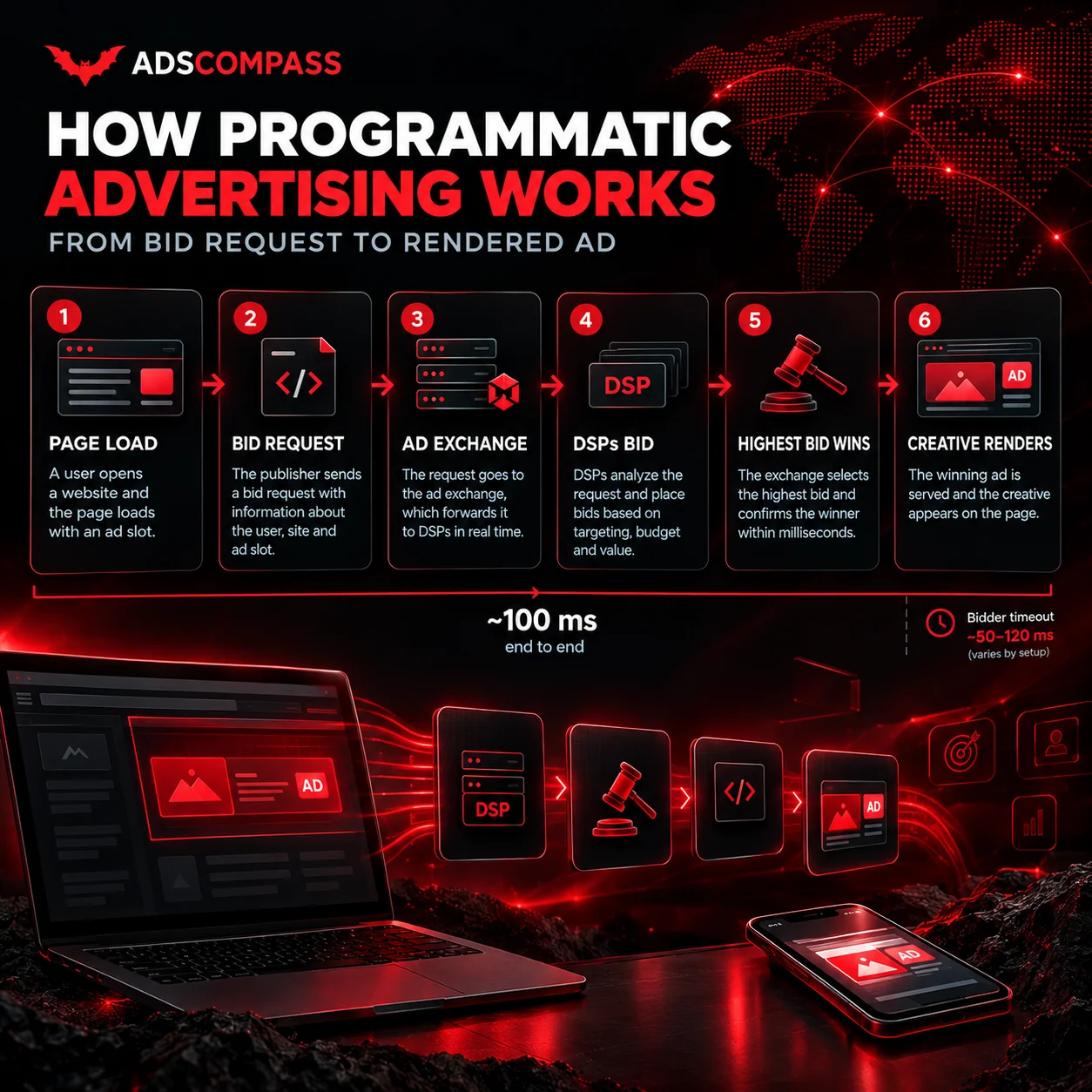
Programmatic advertising works by auctioning each ad impression separately while the page is still loading. The publisher's ad code sends out a bid request describing the slot and the reader's context, connected buyers return prices in real time, and the highest bid wins and renders before the reader notices anything happened. Nobody negotiates and nobody agrees on a price in advance. The whole exchange takes about a tenth of a second. This guide follows that chain in the order the impression travels.
What Programmatic Advertising Automates
Programmatic replaces the negotiation, not the advertising itself. Before it existed, buying a display meant emailing a publisher, requesting a media kit, agreeing a fixed price for a fixed period, and waiting for a report at the end. Programmatic removes all four steps and prices each impression separately, so a reader in Brazil at 3am and a reader in Germany at lunchtime cost different amounts on the same website.
The shift is close to complete. eMarketer puts programmatic at roughly 90% of display advertising budgets worldwide by 2026. What remains is mostly direct sponsorships and local insertion-order buying.
The Four Main Benefits of Programmatic Advertising
Programmatic gives a buyer four things a negotiated placement cannot:
- Price that follows demand. Each impression is priced separately instead of averaged across everyone who visits the page.
- Targeting below the level of the website. A direct deal buys you a site; a bid buys you a device, an operating system version and an hour of the day inside that site.
- Results while the campaign is still running. Statistics update continuously, so a failing creative can be stopped in hours.
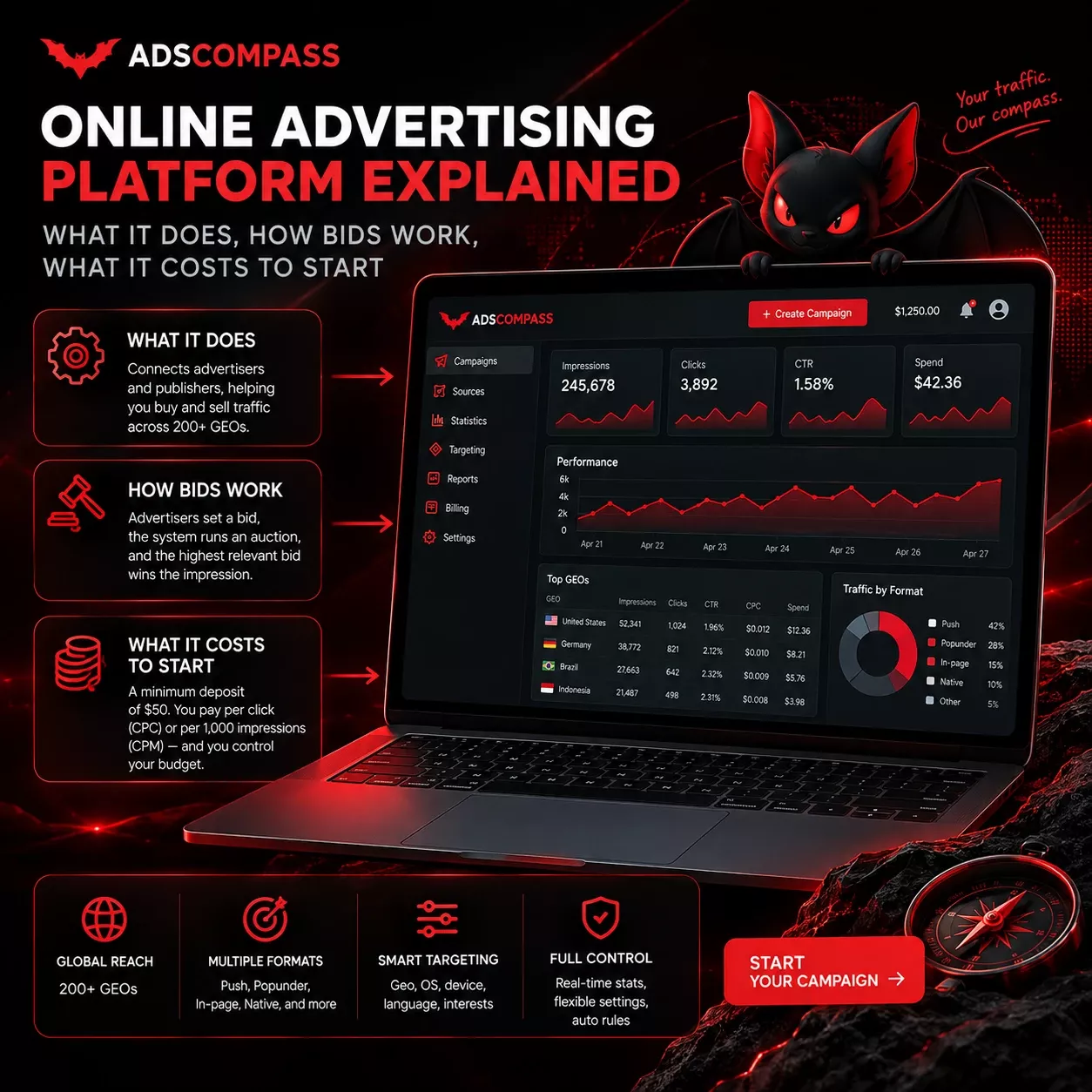
- An entry cost measured in tens of dollars. The smallest possible test is a single impression.
Price is the clearest of the four. On a fixed placement you pay one number for every reader. In an auction you pay separately for a reader in a high-income market and a reader in a low-income one, and you can decline the ones you do not want.
The speed matters more than it sounds. A direct placement reports at the end of the booking period, so a bad creative burns the whole budget before anyone finds out. In an auction the loop between launching a creative and knowing whether it works is measured in hours.
Entry cost decides whether a small advertiser participates at all. A direct placement begins with a minimum you negotiate and a period you commit to, so the smallest test available is whatever the publisher agrees to sell. In an auction the only real barrier is the deposit a platform asks for before it lets you bid.
Key Terms in One Line Each
- Impression - one ad shown to one person one time.
- Publisher - the site or app owner selling the space.
- Inventory - the ad space a publisher has available to sell.
- Creative - the actual banner, video or notification a reader sees.
- CPM - price per thousand impressions.
- CPC - price per click.
- Bid floor - the lowest price an auction will accept for an impression.
- Fill rate - the share of a publisher's own ad requests that come back filled with a paying ad.
How Programmatic Advertising Works, Step by Step
Six things happen between a reader opening a page and an ad appearing, in a fixed order:
- The page loads and calls the ad code. The publisher's tag or SDK fires as the page renders.
- A bid request goes out. It describes the user, the site and the slot: country, device, operating system, browser, ISP, connection type, time.
- The exchange receives it. The request arrives at the auction engine that sits between sellers and buyers.
- Buyers are asked to price it. The exchange broadcasts the request to every connected DSP and demand partner.
- Bids come back. Buyers that want the impression return a price; the rest return nothing.
- The highest bid wins and the creative renders. The ad appears in the slot, usually before the page has finished painting.
At AdsCompass the engine running that loop is ADMY, which houses the SSP, the DSP and the auction in one system, with OpenRTB as the base protocol. The company has run it since 2013 and appears on the IAB Tech Lab voting member list - relevant here because IAB Tech Lab maintains the OpenRTB standard the whole chain depends on.
How long an RTB auction takes
The full auction completes in roughly 100 milliseconds, which is why it can finish before a page renders. The exchange gives buyers a fixed timeout measured in tens to low hundreds of milliseconds; any bid that arrives late is discarded, however high it was.
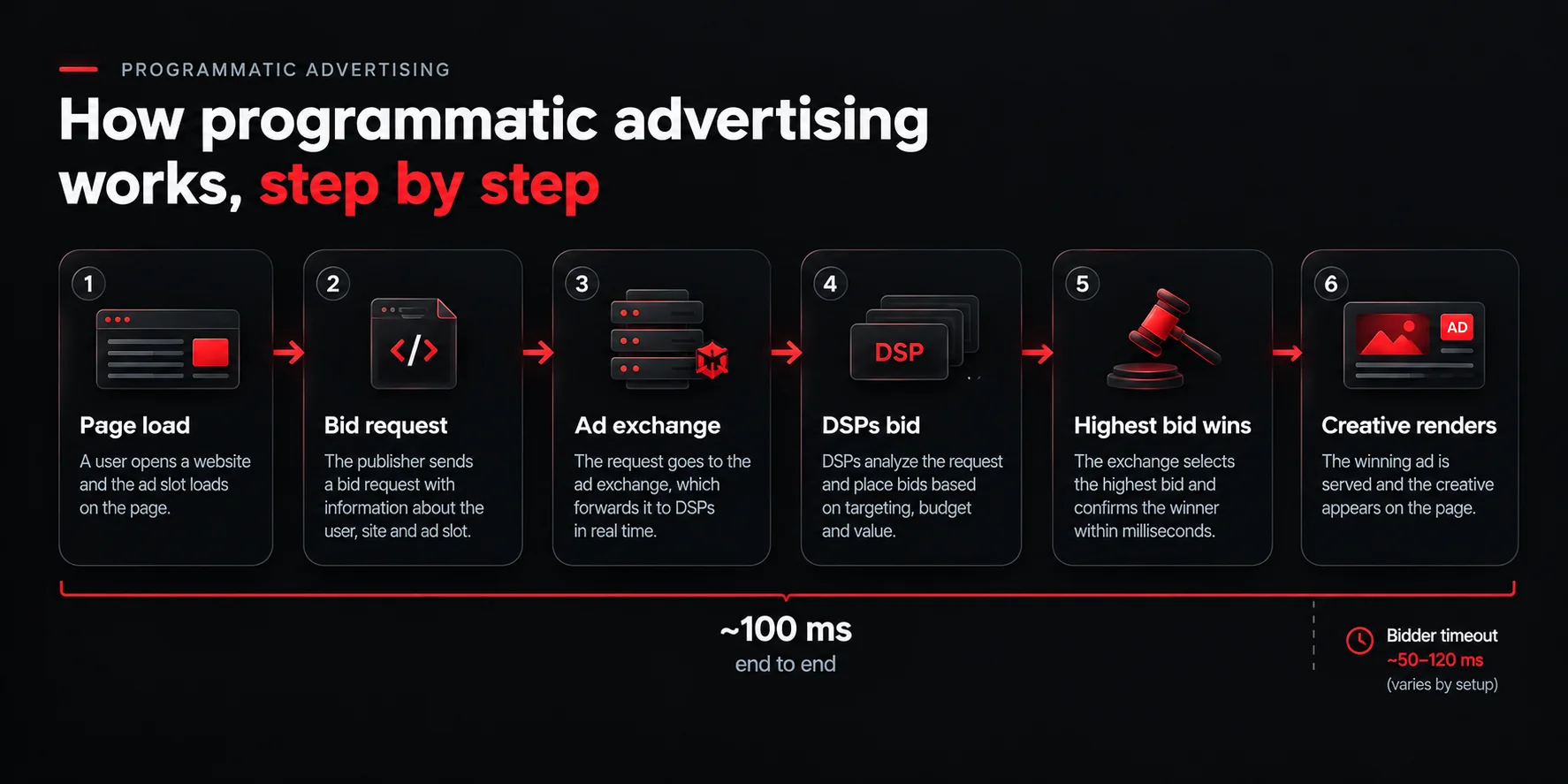
That constraint explains a lot of programmatic behavior: a buyer cannot pause to look anything up, so every decision has to come from data already loaded in memory.
What a bid request actually carries
The OpenRTB specification permits a bid request to carry user and device identifiers, including advertising IDs and IP addresses. Whether it does depends on the exchange. On AdsCompass the information about the user is contextual only - country and city, device, operating system, browser, ISP, connection type and time - with no personal identifiers, so targeting is built from context plus retargeting lists the advertiser uploads or collects themselves.
Programmatic Advertising vs RTB
Programmatic advertising is the category and real-time bidding is one way of transacting inside it. Every RTB deal is programmatic, but not every programmatic deal goes through an auction: direct deals with automated delivery skip it entirely, and by eMarketer's estimates they now take the larger share of programmatic display spend in the US.
| Transaction type | How it works |
|---|---|
| Open RTB auction | Any qualified buyer can bid on any impression |
| Private marketplace (PMP) | The same auction, restricted to invited buyers |
| Programmatic guaranteed | Volume and price fixed in advance, delivery automated |
Only the third of these skips the auction. A private marketplace is still real-time bidding, just with a guest list. Self-serve buying on AdsCompass runs through the open auction, which is why the platform publishes floor prices at all: in an auction a floor is the only fixed number there is.
How an Ad Exchange Differs From an Ad Network
An ad exchange differs from an ad network in how much of the machinery you touch, and not in who owns the inventory. A network sells traffic as a managed service: you pick targeting, set a bid, and the platform handles delivery and optimization for you. An exchange exposes the auction itself, so buyers connect their own systems, receive individual bid requests, and respond to each one in real time. The publisher sets a floor and the competing bids do the rest.
AdsCompass runs both surfaces on top of one auction. Advertisers and publishers who register on the website get the network experience: a dashboard, campaign settings, automated bidding. Platforms that integrate over oRTB or through XML and JSON feeds get the exchange experience: raw bid requests in, bid responses out, their own logic in between.
Which surface suits you follows from that. If you want to launch quickly and let the platform place the bids, the network side is the shorter path. If you have your own bidding logic and want to apply it per request, the exchange side is what you connect to.
What SSPs and DSPs Do
The SSP is the seller's control panel, the DSP is the buyer's, and the exchange is the marketplace where the two meet.
| Layer | Who operates it | What it controls |
|---|---|---|
| SSP | Publisher | Which formats run, floor price, which demand partners may bid, category blocks |
| Ad exchange | Neither party directly | Broadcasts bid requests, runs the auction, awards the impression |
| DSP | Advertiser | Geo and device targeting, bid amount, schedule, frequency, blacklists |
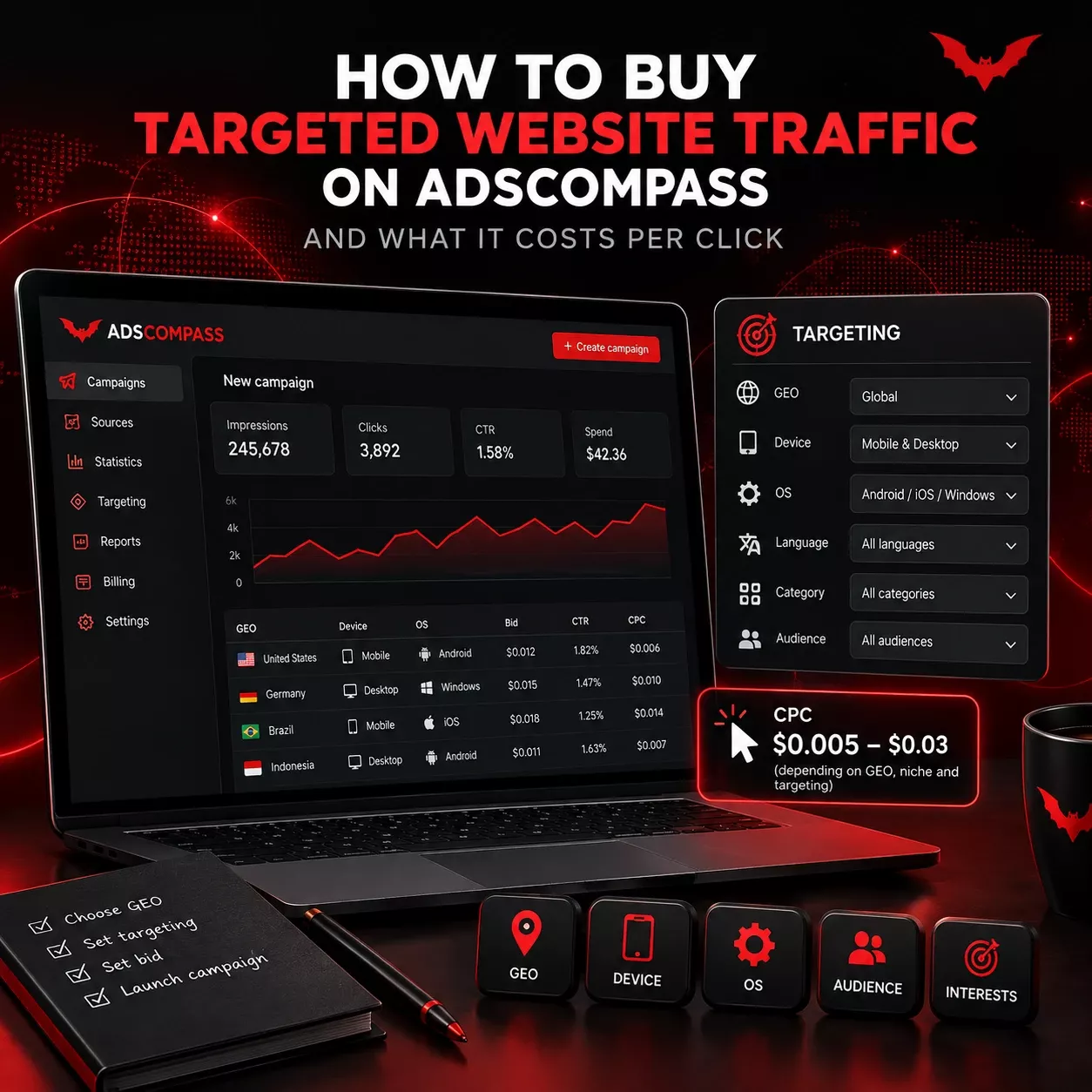
A publisher uses the SSP to set what is for sale and at what minimum. An advertiser uses the DSP to set what to buy and how much to pay: on AdsCompass that covers 200+ countries down to city level, device, operating system and browser with versions, ISP, browser language, connection type, frequency per unique IP per day, and scheduling by hour, weekday and time zone.
Sitting alongside both is the ad server, which is the system that physically delivers the winning creative and counts the impression. Publishers run one to manage all their demand sources together, and it is the ad server's decision that header bidding was invented to influence.
What a First-Price Auction Means for Your Bid
In a first-price auction you pay exactly what you bid, with no discount to the runner-up's price. AdsCompass runs first-price only. This is a declared value in the protocol: in the OpenRTB specification maintained by IAB Tech Lab, auction type is a field in the bid request where 1 means first price and 2 means second price, so any exchange can tell you which it uses.
The practical difference catches beginners constantly. Under second-price, overbidding was nearly free: bid $2, the next buyer bids $0.50, you pay $0.51. Under first-price, that same bid costs you $2. Overbidding by four times means paying four times.
So on a first-price exchange the correct opening move is a low bid raised in small steps until delivery appears. Professional buyers call the discipline bid shading. You do not need the term. You need the habit of starting near the floor and walking up.
What Header Bidding Does for a Publisher
Header bidding is a publisher-side technique that asks several demand sources for a price simultaneously, before the ad server makes any decision. It replaced the waterfall, where a publisher called demand partners one at a time in a fixed order, so a partner ranked fourth only ever saw what the first three declined. Asking everyone at once raises the clearing price, because the best bid wins instead of the first acceptable one.
Header bidding is not among the AdsCompass integration options. Publishers connect through JavaScript tags, direct links and widgets; other platforms connect server-to-server through oRTB, an XML feed or a JSON feed. If a Prebid wrapper is central to your monetization setup, that is a real reason to look elsewhere for that layer, and I would rather say so here than have you find out after onboarding.
What Can Go Wrong: Fraud, Brand Safety and Transparency
Three problems follow programmatic everywhere, and any honest guide has to name them. Invalid traffic means bots and automated clicks charged to advertisers as if a person had seen the ad. Brand safety means an ad appearing beside content the advertiser would never sponsor. Supply chain opacity means a buyer cannot tell how many intermediaries stood between them and the publisher, or whether the seller had the right to sell that inventory at all.
The industry's answer is a pair of public files maintained as standards by IAB Tech Lab. Ads.txt is a file a publisher hosts on their own domain listing every company authorized to sell their inventory; sellers.json is the mirror image, published by an exchange, naming every seller it represents. Together they let a buyer trace an impression back to its origin and discard offers from anyone not on the list. If you are a publisher, ads.txt is the first file to set up, because buyers increasingly refuse unauthorized inventory outright.
The other pattern worth recognizing early is made-for-advertising sites: pages built to carry maximum ad load with content assembled purely to attract cheap traffic. They pass most automated checks and consume real money.
Defense at the ad exchange level is filtering before the impression is charged. AdsCompass premoderates each publisher site before it goes live, then runs antifraud on the traffic behind it, and offers advertisers two filters that are not standard across the market: excluding IPv6 addresses and excluding proxy connections, both of which remove a slice of automated traffic before you pay for it. On the buy side, campaign links are checked against VirusTotal at moderation, and a destination URL carrying a large number of flags is refused.
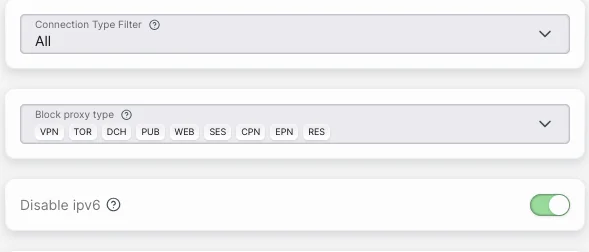
None of this makes fraud zero. It moves the number, and buyers who ignore it entirely pay the difference.
What Happened to Third-Party Cookies and Privacy Sandbox
Third-party cookies are staying in Chrome, and Google's browser-led plan to replace them is over. Most guides to programmatic still describe a countdown to a cookieless web, and that countdown ended.
The sequence: in July 2024 Google confirmed it would not phase out third-party cookies on a deadline. In April 2025 it dropped the planned user prompt as well, stating that it would maintain its existing approach to third-party cookie choice in Chrome. On 17 October 2025 it retired ten remaining Privacy Sandbox APIs, including Topics, Protected Audience and Attribution Reporting, citing low adoption; Chrome began deprecating them in early 2026.
What most coverage compresses into "Privacy Sandbox is dead" is more specific than that. Google retired the advertising APIs and the branding while keeping three narrower technologies - CHIPS, FedCM and Private State Tokens - and it said feedback from companies that had built on the Attribution Reporting API would inform an interoperable Attribution standard pursued through the W3C's Private Advertising Technology Working Group, as AdExchanger reported at the time. The effort moved out of Chrome and into a standards body.
What that means in practice is less dramatic than it sounds. Safari, Firefox and Brave still block third-party cookies by default, so a substantial share of global traffic has been cookieless for years regardless of Chrome. The durable conclusion for a beginner is that cookie-based targeting was already partial, and contextual signals plus first-party data were always the more stable foundation. Formats that never depended on third-party cookies - push, pop, in-page and contextual display - were unaffected by any part of this story, which is why AdsCompass targeting is built on context in the first place.
Where Programmatic Runs Besides Websites
Programmatic buying now covers most digital channels, and display is only the oldest of them. Connected TV sells streaming ad breaks through the same auction mechanics. Digital audio places ads in podcasts and streaming music. Digital out-of-home extends it to billboards and screens, where an impression is estimated from foot traffic rather than counted from a browser. In-app inventory covers mobile applications and games.
AdsCompass sells eight formats and none of them are CTV or DOOH: pop, push, in-page push, banner, native, video pre-roll, and two Telegram Mini App formats added in February 2025. Six of the eight are available to publishers for monetization; the Telegram formats can currently be bought but not monetized. If your plan depends on connected TV or audio, this is a category AdsCompass does not serve, and knowing that now saves you a conversation later.
What It Costs to Start
Cost has two components: the price of an impression, which the auction sets, and the budget it takes to learn anything, which is larger. The auction price cannot be published in advance, but the floor can, and so can the average price the auction actually cleared for a given geo, format and device.
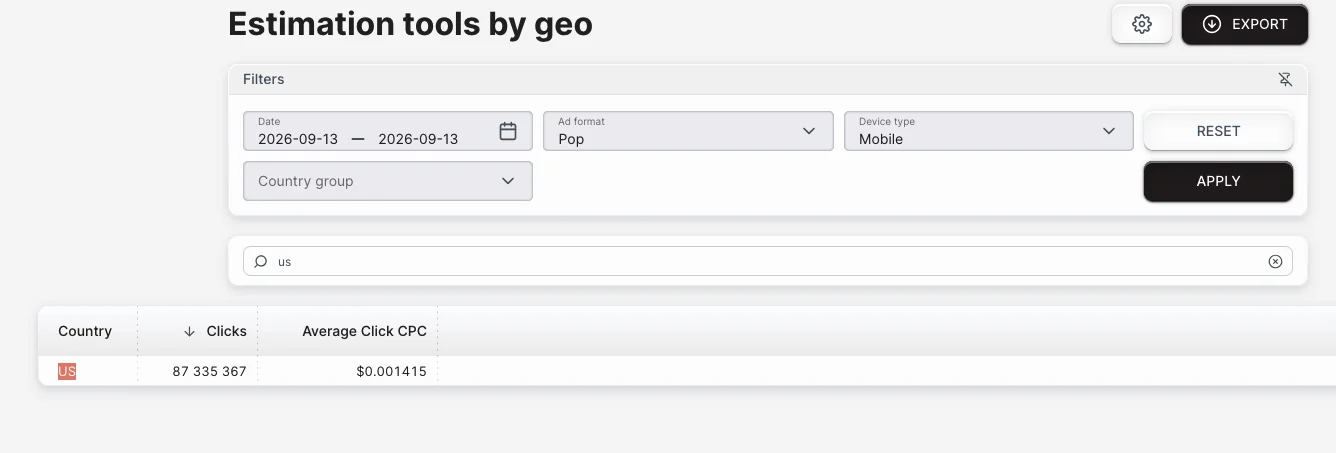
Floors differ sharply between formats, and the gap says more about pricing units than about quality. A cost-per-click format and a cost-per-thousand-impressions format are not comparable purchases, so a $0.0003 figure and a $0.1 figure in the table below describe two different things.
| Format | Pricing model | Minimum bid |
|---|---|---|
| Pop | CPC | $0.0003 |
| In-page Push | CPC | $0.0008 |
| Push | CPC | $0.001 |
| Banner | CPM | $0.001 |
| Telegram Rewarded Post | CPM | $0.01 |
| Native | CPM | $0.1 |
| Video Pre-roll | CPM | $0.1 |
| Telegram Rewarded Video | CPM | $0.1 |
How Much Traffic Runs Through the Exchange
AdsCompass serves 8 billion impressions and 60 million clicks a day. One figure counts ads that actually ran, the other counts people who actually acted on them.
| Stage | Daily volume |
|---|---|
| Impressions served | 8 billion |
| Clicks | 60 million |
Sixty million clicks against 8 billion impressions is a click on roughly 0.75% of everything delivered. That is a blended average across eight formats and 200+ countries, so treat it as the scale of the pool rather than a benchmark for your own campaign: a pop campaign in one geo and a native campaign in another sit a long way either side of it.
No single advertiser buys against that whole pool. Targeting narrows it immediately - one format, one country, one device class - and the share left after that is what your bid actually competes for. The traffic estimation tool shows the volume available for your own combination, counted in the unit that format is billed in: for Pop, which is priced per click, each opened pop counts as one billable click. Plan a budget against the estimate for your combination rather than the platform total.
When you line up one online advertising platform against another, ask for daily impressions and clicks: 8 billion and 60 million are the numbers to hold the comparison against.
Where to Start, on Either Side of the Auction
Start with one variable, because that is the only configuration where a result can be attributed to a cause.
If you are buying, pick one format and one country. Open the traffic estimation tool first and compare the floor against what that format is currently clearing in your target market: the gap between those two numbers is the competition you are bidding into. Then set a bid just above the floor and raise it in small increments until the campaign delivers. On a first-price exchange that sequence protects you from paying for a bid nobody was going to challenge.
If you are selling, publish an ads.txt file before anything else, then start with one format on one site rather than tagging everything you own at once. A floor set too high leaves inventory unsold; a floor set too low sells it for less than it was worth. The only way to find the right number is to watch the fill rate and revenue move together over a few weeks.
FAQ
Is programmatic advertising the same as display advertising?

What is the difference between programmatic and Google Ads?
What is OpenRTB?
How long does an RTB auction take?
What is the difference between a DSP and an SSP?
What is a bid floor?
Is programmatic advertising worth it for a small business?
Does programmatic advertising use personal data?