
Buy Dating Traffic by Format, Bid and Test Budget
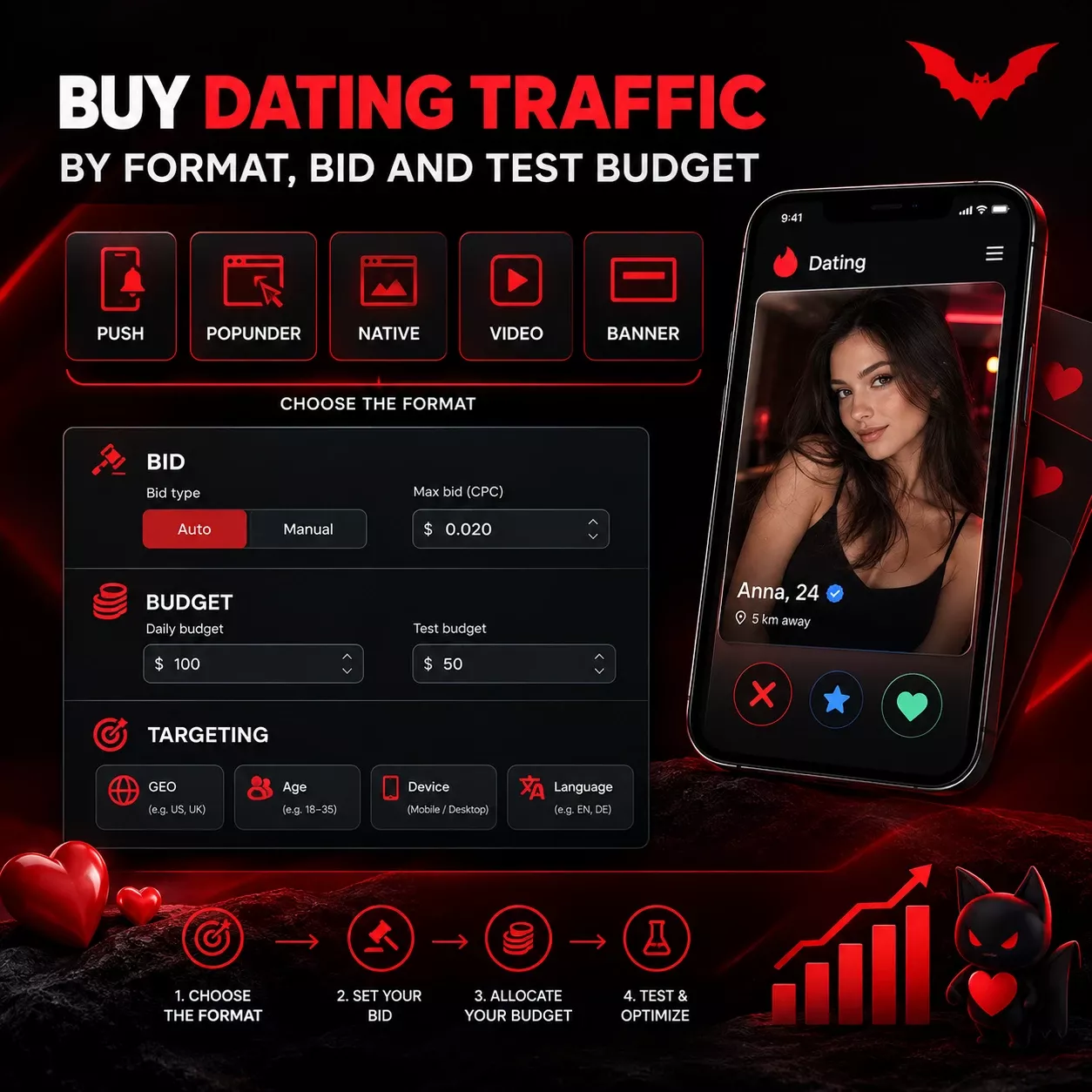
On AdsCompass a dating campaign runs in whichever of the eight ad formats you choose, costs whatever you bid, and lasts as long as the test budget behind it. Dating traffic itself is ad inventory that drives registrations on dating sites and apps. For affiliates it is bought against offers that pay per lead. That puts the whole calculation on one axis: the payout at the top, the price of a single click at the bottom. Bids go into a first-price OpenRTB auction, so the number you type is the number you pay.
Eight Ad Formats Carry Dating Traffic
You can buy dating traffic on all eight AdsCompass formats, with no format-level restriction on the vertical, so your offer flow decides the choice rather than a policy limit. What separates the eight first is the billing model. Three charges per click, the other five per thousand impressions, and that split changes how a test budget behaves before a single banner exists.
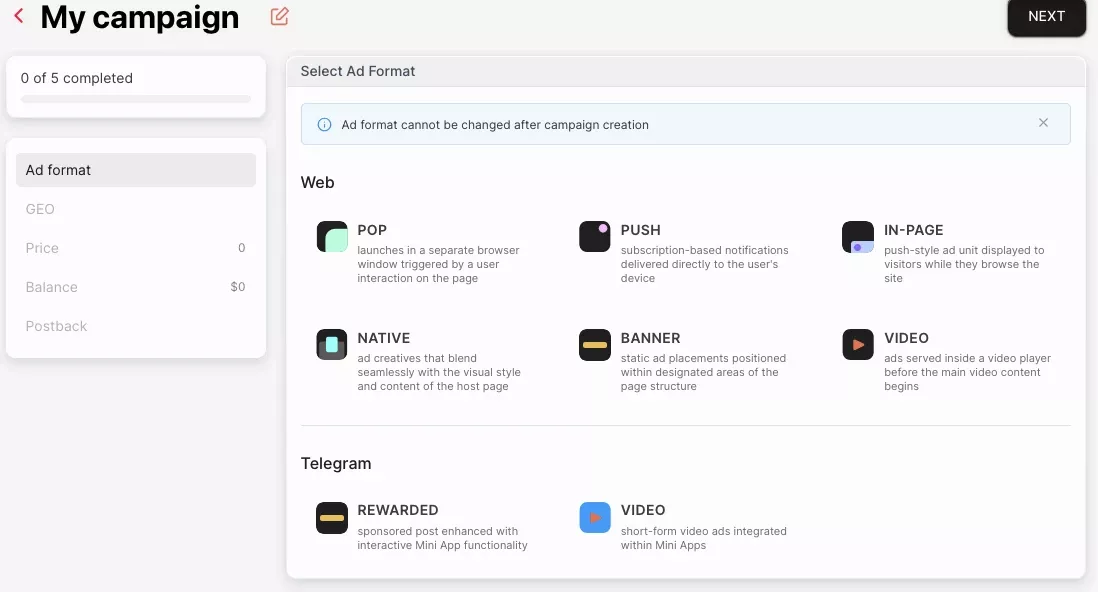
Bids move with the auction. The floors below do not, which is why the table works as a fixed reference and the Traffic Calculator as a live one.
| Format | Minimum bid | Billing | Fits dating offers that |
|---|---|---|---|
| Pop | $0.0003 | Per click | Convert on a short flow: photo, location line, registration form |
| In-page push | $0.0008 | Per click | Use a chat-alert angle where classic push is unavailable |
| Push | $0.001 | Per click | Use a chat-alert angle and can carry a prelander |
| Banner | $0.001 | Per 1,000 impressions | Lean on retargeting and repeat exposure |
| Telegram Rewarded Post | $0.01 | Per 1,000 impressions | Work inside a messaging habit, mobile first |
| Native | $0.10 | Per 1,000 impressions | Need a longer read before the click |
| Video pre-roll | $0.10 | Per 1,000 impressions | Need a scene rather than a headline |
| Telegram Rewarded Video | $0.10 | Per 1,000 impressions | Trade attention for an in-app reward |
The right-hand column describes the offer flow each format is built for, drawn from how dating traffic is usually run on these placements. It is a starting point for the test, and your own source report replaces it within a week.
Formats billed per click
Pop at $0.0003, in-page push at $0.0008 and push at $0.001 are priced per click, not per thousand impressions. This is where most dating budget calculations break. A pop click at the floor works out to about 3,300 clicks for a single dollar, and a test built on that assumption looks nothing like a test built on a CPM format sitting at a similar-looking number.
You will not buy at the floor, and you should not plan as if you will. The floor is the price at which the auction accepts your bid, not the price at which it starts delivering volume, and on a competitive dating GEO the clearing price sits well above it. Read the floor as the lower bound of the auction and take the working number from the Traffic Calculator, which prices against auctions that have already closed.
Pop, short for popunder, opens your landing page in a separate tab or window behind the page the user is reading. It suits dating offers that convert on a short flow: a photo, a location line, a registration form.
Push arrives as a notification and reads like a message someone sent you, which is why dating creatives on push imitate a chat alert. In-page push is a banner styled to look like a notification, served inside the page itself, which is how it reaches devices and browsers that no longer accept classic push subscriptions. It sits between the other two on price.
Formats billed per thousand impressions
The other five formats bill per thousand impressions, from $0.001 on banner to $0.10 on native, video pre-roll and Telegram Rewarded Video. Paying by impression moves the risk onto the creative. A banner nobody notices still costs you money. Telegram Rewarded Post and Telegram Rewarded Video joined in February 2025 and are the two newest placements on the platform.
Native puts your dating ad inside a publisher's content feed, so it inherits the page design. The person clicking it was reading an article a second earlier, and that is a different state of attention. Video pre-roll runs before the publisher video and gives a dating offer room for a scene. The two Telegram formats put the ad inside Telegram Mini Apps, where the user is already sitting inside a messaging habit.
There Is No Fixed Price List for Dating Traffic
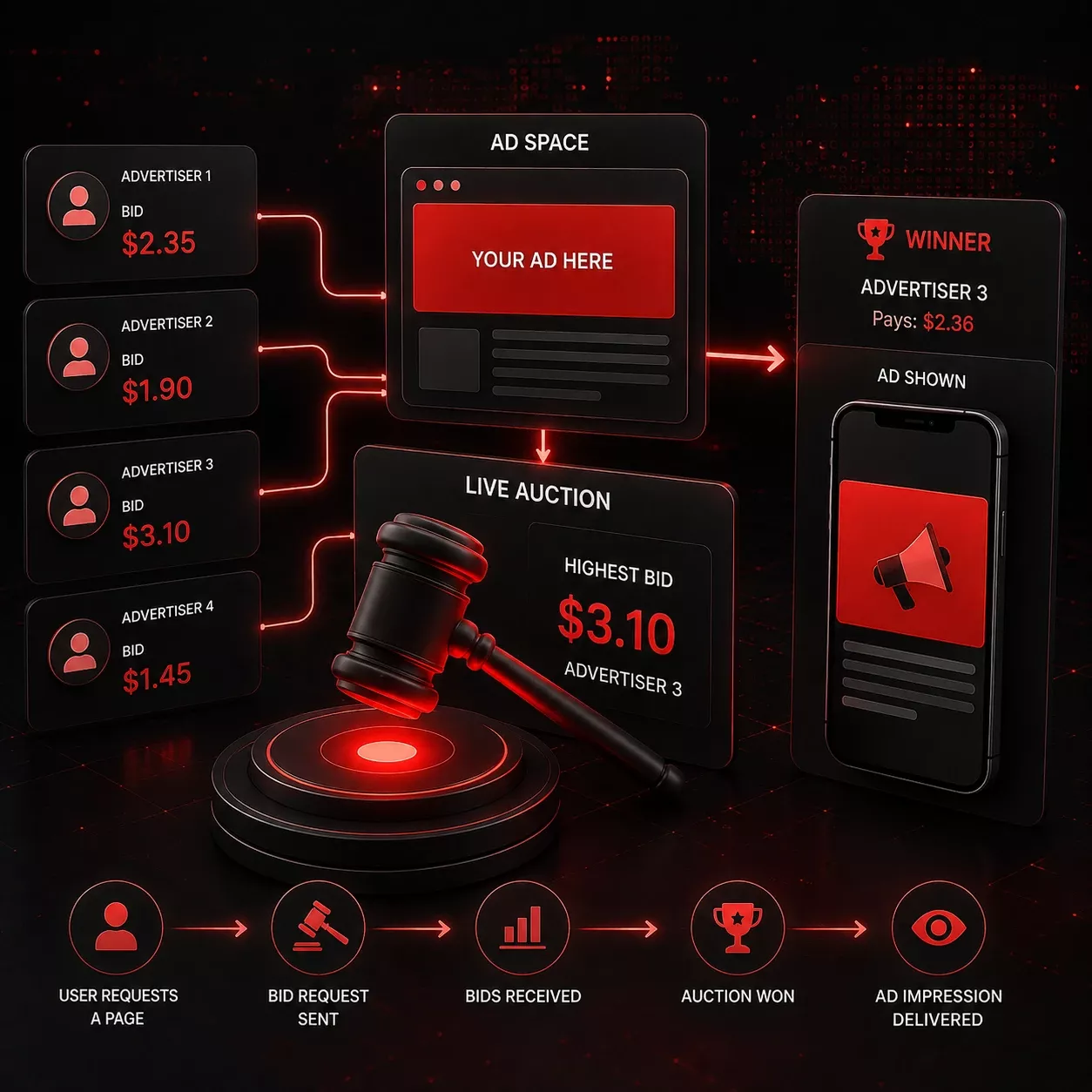
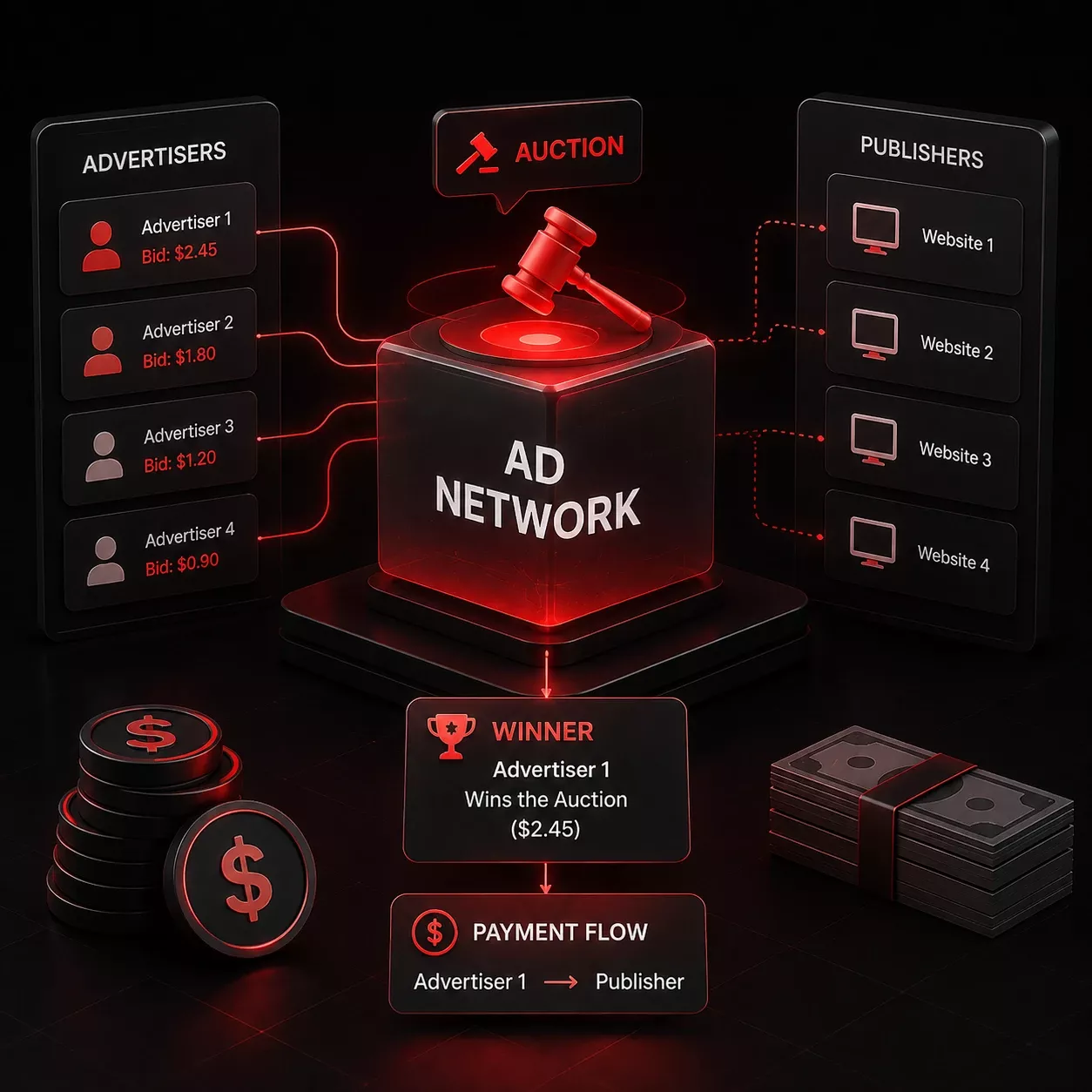
AdsCompass runs a first-price auction on OpenRTB, the bidding protocol maintained by the IAB Tech Lab. The price you pay is the price you bid.
The exchange has been running since 2013 and serves 8 billion impressions and 60 million clicks a day across 200+ countries, with 6,500 to 9,000 active advertisers and 3,000 to 5,000 publishers on its two sides. That is the field your dating campaign is priced against. Part of the market still runs second-price auctions, where the winner pays slightly above the runner-up. Here the bid is the price, so bid management becomes a daily task.
What your real cost ends up being depends on three things: what other advertisers are bidding for the same inventory, who the publisher's audience is in terms of GEO and device, and which format you picked. Dating traffic competes for the same impressions as every other vertical on the exchange. A bid that wins volume in one country at nine in the morning can win nothing in another at midnight. Prices move on their own while your campaign sits untouched.
Those numbers become visible in the Traffic Calculator inside the advertiser account. It shows average bids by GEO and format, refreshed from auctions that have already completed, and it changes its recommendation depending on what you ask it for. Ask for maximum click volume and you get one number; ask for the cheapest clicks in a GEO and you get another. Registration is free and the calculator needs no deposit, so read the numbers before you fund anything.
What to Check in a Dating Ad Network Before You Deposit
Seven things decide whether dating traffic can be steered at all, and every one of them is checkable before any money moves. A dating traffic source is worth only as much as the control you have over it once the campaign is live, which matters more than the floor you paid to reach it. Here is where AdsCompass stands on each point.
- Auction model. First-price or second-price changes how you manage bids day to day. AdsCompass runs first-price only.
- Source ID in the postback. Without it, optimization is guesswork. AdsCompass passes source ID among its macros.
- Source-level reporting. Totals by day tell you nothing about which placement paid off. Reporting here breaks down by day, hour, GEO, source and site.
- Per-source bidding. Reallocating the budget matters more than raising a bid. Micro Bidding sets a separate price per source ID.
- Minimum deposit. This sets how cheaply you can find out that an offer does not work. The floor is $50, and $500 is the recommended first test.
- Moderation speed. A day of waiting per creative iteration kills a test schedule. Campaigns clear in roughly ten minutes here.
- Traffic filters. Proxy and IPv6 exclusion cut part of the automated traffic before it costs you. Both are available at setup.
The order matters. An ad network can have cheap floors and still be unusable for dating if source-level data never reaches your tracker, because then every optimization decision you make is made blind.
GEO Selection Starts With Your Offer Payout
The best GEOs for dating traffic are not the ones with the highest payouts, they are the ones where the payout clears the local bid. That arithmetic runs between what your offer pays and the bid AdsCompass shows for that country. A generic list of top dating countries will not survive contact with your payout. The method has three steps and takes about ten minutes inside the Traffic Calculator.
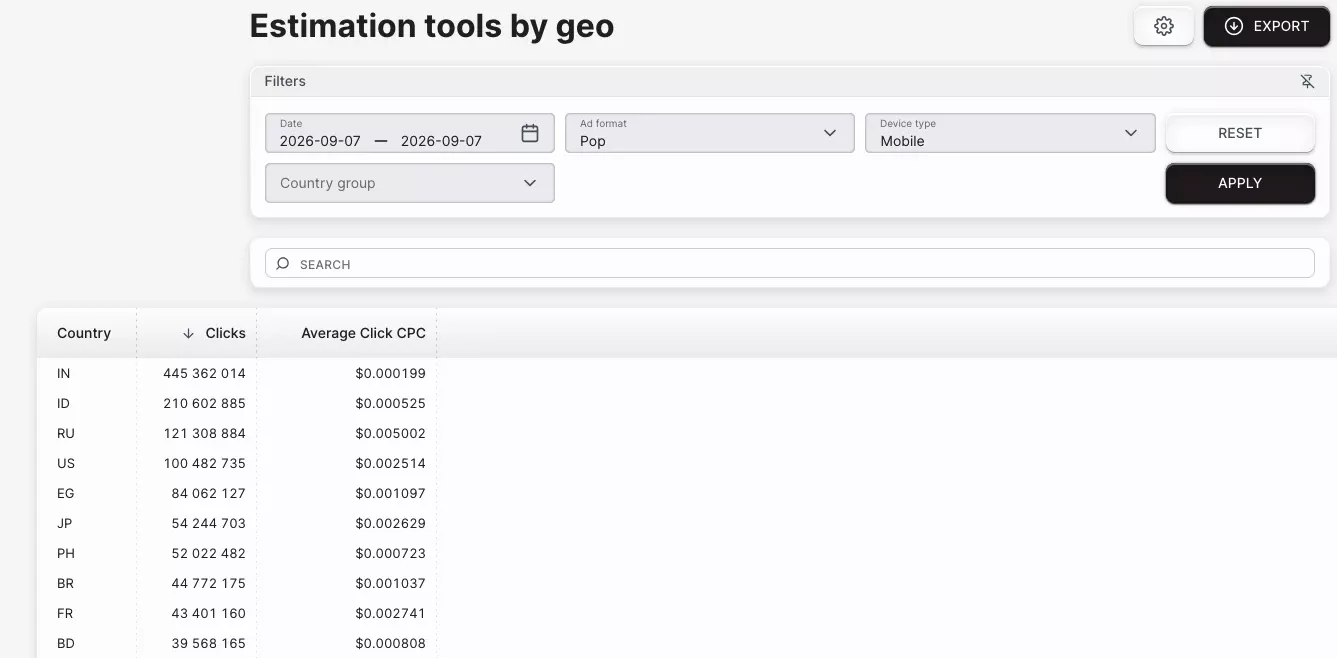
Start with the payout and the flow behind it. A single opt-in, or SOI, pays less per lead and converts more of the clicks, because the user finishes at the registration form. A double opt-in, or DOI, pays more and converts less, because the confirmation step drops part of the volume.
Multiply the payout by the conversion rate you assume, and you have the ceiling for one click. A $2 payout at 1% leaves $0.02. That is break-even, so bid under it on the first test and let the sources that convert earn the raise.
Run the number twice, pessimistic and realistic, then take the pessimistic ceiling into the Traffic Calculator and filter by your GEO and format. Countries where the average bid sits above that ceiling are not bad countries, they are countries where your offer cannot pay for the traffic.
This reordering matters because dating payouts and traffic prices do not move together. A Tier 1 country with a high payout can still be unaffordable, because every vertical on the exchange is bidding for the same audience. Targeting reaches 200+ countries and goes down to city level, so a GEO that fails as a whole may still work as three cities.
On pop, the countries where a dating traffic budget stretches furthest are the ones with lower clearing prices: the United Arab Emirates, Mexico, Turkey, Indonesia and Malaysia come up in that group. Tier 1 stays viable when the offer pays enough to absorb a higher clearing price, so sort your shortlist by the gap between payout and bid.
The Traffic Calculator filters by mobile, desktop or all devices. On dating the mobile and desktop numbers for the same country are worth reading separately before you commit a bid.
Targeting Removes Junk Traffic Before Optimization Starts
Targeting is where a dating campaign stops paying for people who were never going to register, and it is set before any optimization work begins. Traffic for dating sites converts on fit rather than volume, so the narrowing happens here.
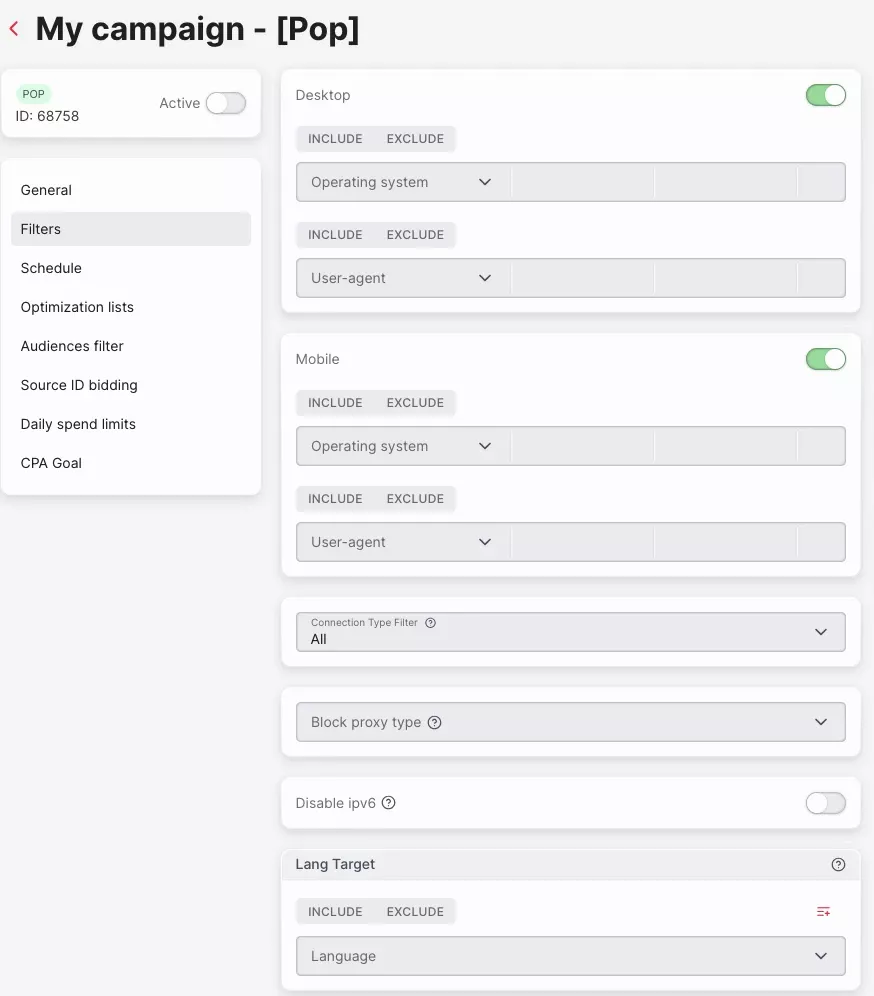
AdsCompass gives eight targeting parameters and two exclusion filters at setup:
- GEO and city
- Device type, OS and OS version
- Browser and browser version
- ISP or mobile carrier
- Browser language
- Connection type
- Retargeting through saved audiences
- IPv6 address exclusion
- Proxy connection exclusion
IPv6 exclusion and proxy exclusion deserve their own line. Both remove part of the automated traffic before it ever reaches your landing page, and neither filter is standard across the market. They sit on top of the platform's own screening, where every publisher site is moderated before it goes live and an anti-fraud layer filters bot traffic afterwards.
Browser language matters in dating specifically. A creative written in Portuguese served to a Brazilian user whose browser is set to English will underperform, and language targeting is a far cheaper fix than a new creative set. Frequency is capped per unique IP per day, and scheduling runs by hour and weekday in a timezone you select, which lets a campaign run only during the evening hours when registration flows actually get finished.
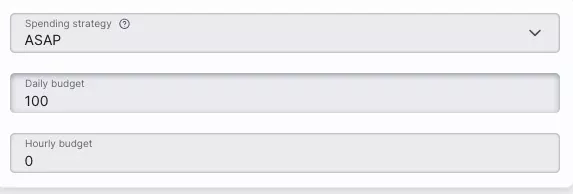
Budgets are set at daily and hourly level. A spend mode decides whether the money is paced across 24 hours or spent as fast as the auction allows. For a first test, pick the paced option: it produces hourly data you can read.
The Test Budget Matters More Than the Deposit Minimum
You can buy dating traffic from a $50 deposit, though the recommended test budget for a dating offer is $500. A campaign never buys from one place. It pulls from many traffic sources at once, and each source needs its own spend before its numbers mean anything: about a tenth of the EPC you are aiming for, adjusted for the format you picked. Across all the sources one dating campaign reaches, that adds up to $500. At $50 you get a few clicks per source and nothing to decide on.
There is no default daily budget and no floor, so you set it yourself. For the test, divide the budget by the number of test days: $500 over five days is $100 a day for one campaign. After the test that rule stops working, because the mix of targeting options and offers is too wide for a single formula.
Funding the account is not a bottleneck. AdsCompass takes Capitalist, USDT TRC-20, Bitcoin, PayPal, Visa and Mastercard, Apple Pay and Google Pay, Paxum, WebMoney and wire transfer, all in USD. The list was current at my check on 4 September 2026.
Campaign Setup in Order
These eight steps are the order in which you buy dating traffic on AdsCompass, and the order matters because each step narrows what the next one has to decide.
- Pick the offer and note its payout and flow, SOI or DOI.
- Open the Traffic Calculator, compare average bids in your candidate GEOs against the click ceiling your payout allows, and shortlist the countries that clear it.
- Choose the format from the table above, matching it to the offer flow rather than to the cheapest floor.
- Set targeting: GEO and city, device, OS, browser, ISP, browser language, connection type, plus the IPv6 and proxy exclusions.
- Connect the tracker through S2S postback and confirm the source ID reaches it, because nothing after this step works without that.
- Set the total budget, the daily budget and the spend mode, pacing across the day for a first test.
- Upload the creatives and build the campaign link, then open it once in a browser to check every macro is populated.
- Submit for moderation and watch the first hours of the source report rather than the campaign total.
Step 5 is the one that gets skipped under time pressure and the one that costs the most, because a test that runs without source-level conversion data has to be run again.
Moderation Takes About Ten Minutes and Rejects on Three Things
Dating traffic clears AdsCompass moderation in roughly ten minutes, occasionally longer. That figure and the three causes below came out of the same check I ran on the live platform on 4 September 2026. Almost every rejection traces back to one of them, and the dating vertical itself is not among them.
The first is a violation of the platform's terms and conditions. The second is a malformed campaign link: a tracking URL with a broken macro or a missing parameter fails before anyone looks at the creative. The third is a destination URL that returns a high number of alerts on VirusTotal, which happens more often than affiliates expect when a domain has been used by someone else before.
Violence, weapons and drugs are prohibited content regardless of vertical. For dating that lands on your images and headlines, which is where moderators look first.
Verify the link before you submit it. Ten minutes of checking saves a rejection cycle. Paste the exact URL you put into the campaign, confirm it redirects where you expect with every macro populated, and run the destination domain through a reputation check when you bought the domain second-hand.
If something is stuck, support runs around the clock through the Telegram chat, in English and Russian. Every account also has a personal manager whose contacts sit in the left menu of the dashboard.
Scaling Happens at Source Level
After a dating campaign has spent its test budget, the next move is to redistribute the same money across sources. Reporting breaks results down by day, hour, GEO, source and site, and the source-level view is where dating traffic is won or lost. The best traffic sources for dating offers are never known in advance; they are the handful that survive your own report at the end of the test.
One thing to know before you plan the work: there is no automatic conversion optimization here. No algorithm reallocates budget toward converting sources overnight while you sleep. Optimization here is manual, done through the tools below, and it costs you daily attention that an automated bidder would not. Whether that is a drawback depends on whether you would rather control the reallocation or delegate it.
Conversions have to come back through S2S postback for any of this to work. The platform passes campaign ID, creative ID, price, IP, source ID, user agent and click ID as macros, and the one that matters here is source ID: without it in your tracker you can see which sources produced clicks, but not which ones produced registrations.
Source ID bidding
Source ID bidding, called Micro Bidding in the AdsCompass interface, sets a separate price for individual traffic sources instead of one bid for the whole campaign. You upload a list of source IDs in advance and attach a rule to it, then raise the bid where conversion rate holds and cut it where click-through rate has dropped. This is the main lever the platform gives a dating campaign, and it is the reason the manual approach is workable at all.
Blacklists and whitelists work alongside it at IP, ISP and source ID level, so a source that delivers clicks and no registrations can be repriced first and excluded only if it stays bad. Audiences add the retargeting layer: upload a ready list, set automatic collection rules, and define how long a user stays in the audience. Collection runs through the SST Pixel, and in dating this usually means bringing back people who opened the registration form and left.
A five-day optimization schedule
The five days of a dating traffic test split into three jobs, and doing them out of order wastes the budget. This is the sequence that fits the data-collection window rather than a rule the platform enforces.
- Days 1 and 2, collect. Leave bids alone. A change here resets the data you are paying to gather.
- Day 3, cut. Open the source report. A dating traffic source that spent past your own threshold without a single conversion gets its bid cut rather than blocked, because clicks without registrations can be a creative mismatch instead of bad traffic.
- Day 4, push. Raise the bid on every dating traffic source where conversion rate held, through Micro Bidding rather than the campaign bid, so the increase stays contained. Blacklist the day 3 sources that stayed flat.
- Day 5, decide on the offer. If no source has cleared your target cost per lead by the end of the window, the problem sits upstream of the traffic and a bigger budget will not fix it.
Write your cut-off numbers down before day 1: how much a source may spend without converting, and how far a bid moves when it does convert. Deciding that while you are watching money leave the account produces worse decisions than deciding it in advance.
FAQ
Can I target dating traffic by age or gender?

Do dating offers need a prelander?
Can I test dating traffic without a tracker?
Is adult dating traffic allowed?
How long before a dating campaign shows whether it works?