


Ad Network Explained: Auctions, Bids and Who Gets Paid
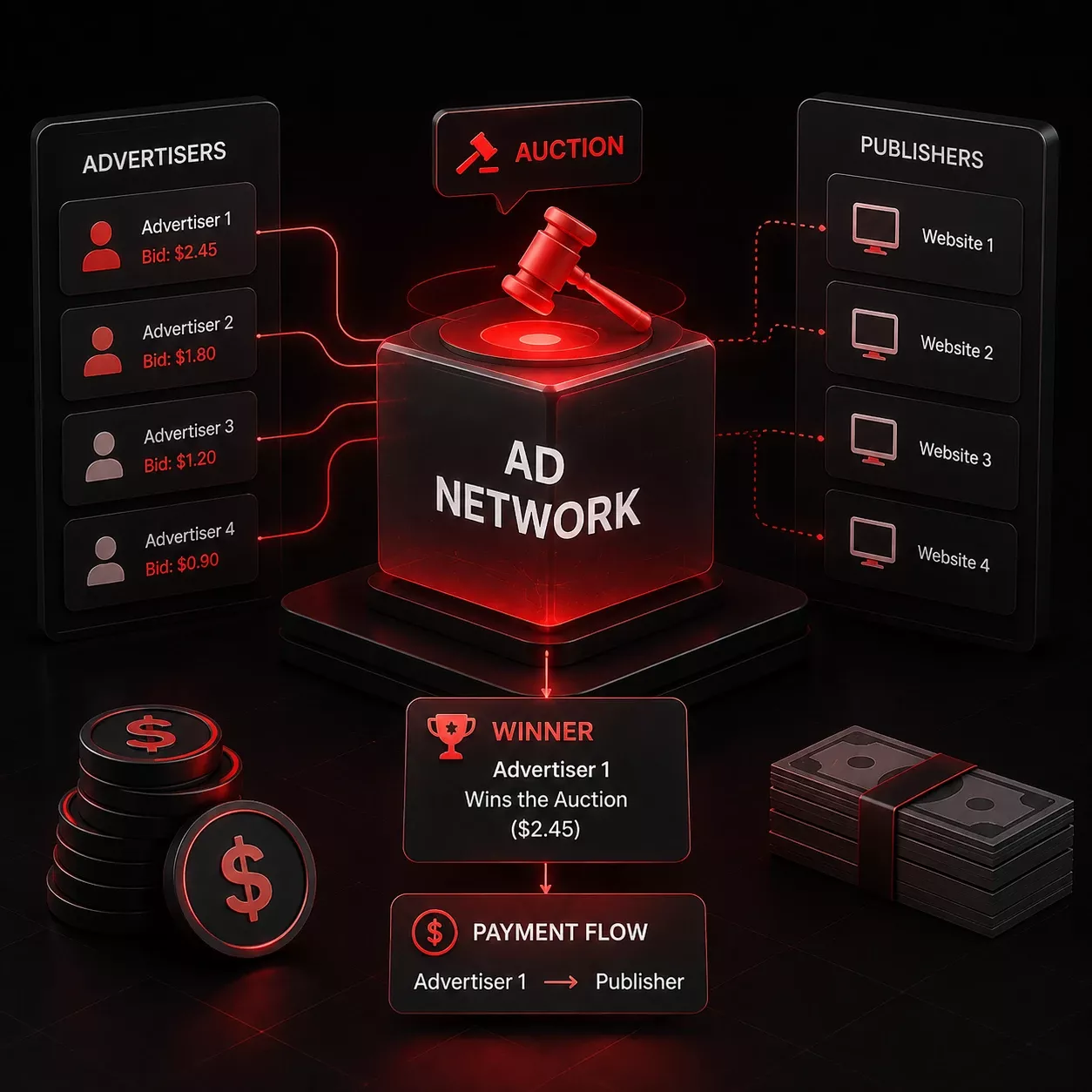
An ad network is an intermediary that aggregates advertising inventory from many publishers and auctions it to advertisers, paying the publisher a share of the winning bid and keeping the difference.
The advertiser pays per click or per thousand impressions. The publisher installs a code and is paid for the traffic it fills. The advertising network runs the auction, moderates the ads, screens the traffic and settles the payments.
Why Ad Networks Exist: The Four Problems They Solve
An ad network exists because neither side of the market can transact directly at scale, and in standing between them it takes on four separate jobs: discovery, unsold inventory, pricing and settlement. A large publisher can employ a sales team; the long tail of sites cannot. An advertiser who needs traffic in forty countries cannot sign forty thousand contracts. Aggregation turns many small supplies into one buyable pool, and the four jobs are what that pool costs to run.
Each of the four is a cost somebody would otherwise carry.
Discovery. A site with 20,000 visitors a month has no way of being found by an advertiser who would happily buy its traffic, and no budget to go looking. Aggregation replaces that search with a single integration on each side.
Unsold inventory. Even publishers who sell directly sell only part of what they have: the wrong hours, the wrong countries, the remainder after the direct campaign is capped. Unsold impressions expire worthless the moment the page loads, so any price above zero beats holding them.
Pricing. One publisher has no idea what a Brazilian mobile impression is worth on a Tuesday night. A network sees millions of comparable impressions and prices each one against live demand.
Trust and settlement. Neither side has to check the other's numbers or chase an invoice across a border. The network counts the impressions, screens the traffic, absorbs the credit risk on both sides and settles in one currency.
What Real-Time Bidding Changed
Real-time bidding turned the network from a wholesaler into an auction operator. Before RTB arrived around 2010, a network bought inventory in bulk and resold it at a markup, so the price was negotiated once and applied to millions of impressions. After RTB, the same intermediary prices each impression separately, at the moment it is served, against whoever else wants that user.
The consequence runs through everything below. There is no rate card, the price of the same placement moves through the day, and the number an advertiser controls is a bid rather than a cost.
What Happens Between a Page Opening and an Ad Appearing
An ad reaches a user through a fixed sequence that completes in roughly 100 milliseconds, before the page has finished rendering.
- A user opens a page or an app screen carrying the publisher's ad code.
- The code fires an ad request to the network.
- The network builds a bid request describing the opportunity - country, device, browser, operating system, placement identifier - along with the technical identifiers the auction needs, such as IP address and user agent. It carries no name, email or account identity: a buyer targets an audience profile, not a person.
- That request is matched against every active campaign whose targeting fits the description.
- The matching campaigns compete in an auction, and the highest eligible bid wins.
- The winning creative is returned to the page and rendered in the placement.
- The impression is recorded, and if the user clicks, the click is recorded against the campaign.
- The advertiser's tracker receives a postback with the campaign, creative and source identifiers, so conversions can be attributed back to the placement that produced them.
Steps 3 to 6 are the part that has to be fast. Everything else in this article is detail hanging off that loop.
Types of Ad Networks and Where This One Sits
Digital ad networks are commonly grouped into five types, and the dividing line is what each one sells.
| Type | What it sells | Who it suits |
|---|---|---|
| Vertical | Inventory in one topic or industry | Advertisers who need contextual fit |
| Horizontal | Volume across many topics, sorted by targeting | Performance buyers chasing scale |
| Premium | Named publishers, agreed placements | Brand campaigns with placement requirements |
| Blind | Inventory without site names disclosed | Price-driven buying at volume |
| Specialized | One format or channel - mobile, video, native, in-app | Format-specific campaigns |
The taxonomy is not standardized, and most real networks straddle two or three of these. In practice an advertiser meets search-engine display networks, content recommendation widgets and in-app mediation SDKs most often. AdsCompass is a horizontal performance network weighted towards Pop and Push inventory, where placements are identified by source ID and not by site name. How popunder ads are bought and sold inside that model is covered separately.
How Advertisers Pay: CPC, CPM and the Models Around Them
An advertiser pays either for volume of ads served or for an action the user takes, and the model determines what the bid figure actually means.
| Model | You pay for | Where it is used |
|---|---|---|
| CPM | One thousand impressions | Banner, video and rewarded placements, and reach campaigns |
| CPC | One click | Performance campaigns where the click is the first measurable step |
| CPA | One completed action - sale, deposit, registration | Affiliate and CPA networks rather than self-serve traffic buying |
| CPL | One lead | Lead generation verticals |
| CPI | One app install | Mobile app promotion |
| CPV | One video view | Video campaigns |
Two bids in different models cannot be compared as written. A $0.1 CPM works out at $0.0001 per impression, and to set it against a $0.001 CPC you need a click-through rate: at 1% CTR, that thousand impressions produces ten clicks, so the effective cost is $0.01 per click - ten times the CPC floor. Run that conversion before deciding a CPM format looks cheap.
The Four Parties in an Ad Network and What Each One Does
An ad network connects four parties: advertisers who buy traffic, publishers who sell inventory, the network itself running the auction, and other platforms - networks, SSPs and DSPs - that connect their supply or demand over RTB.
| Party | What they do | How they connect |
|---|---|---|
| Advertiser | Buys traffic, sets bids and targeting | Self-serve account, or through a manager at volume |
| Publisher | Monetises their own sites | Separate self-serve account |
| The network | Runs the auction, moderates ads, screens traffic, settles payments | - |
| Other networks, SSPs, DSPs | Add supply or demand to the same auction | RTB integration through a manager |
Advertiser and publisher accounts are separate systems with separate dashboards and separate documentation. Anyone buying and selling traffic at the same time registers twice, and the two balances never meet.
The fourth row matters more than it looks. AdsCompass connects other networks over oRTB, XML feed and JSON feed as a declared part of the model, so the inventory an advertiser bids on includes supply arriving through partner platforms, not only sites that registered directly.
Where Your Money Goes When You Buy Traffic Through an Ad Network
The advertiser's bid is the price of one click or one thousand impressions, the publisher receives a share of that bid, and the network keeps the difference. There is no fixed commission percentage anywhere in this model, because the bid itself changes with every auction.
The auction type decides what a winning bid costs. In a second-price auction the winner is charged the runner-up's bid plus a small increment, so bidding above the market does not, by itself, raise what you pay. In a first-price auction the bid is the price: win, and the full amount entered is what leaves the balance. AdsCompass runs first-price on OpenRTB, and advertisers who scale successfully here tend to raise bids in small increments and watch the win rate move before the next step.
Part of what an advertiser spends can come back. On AdsCompass the balance receives cashback starting at 1% of spend and rising with turnover, credited to the account rather than paid out, so it funds the next campaign instead of the bank.
There is no fixed price for traffic either. What you pay depends on what other advertisers are bidding for the same audience at that moment, on the GEO, on the device mix of the site and on the format - a push ad click in Indonesia and a push click in Germany are two different markets with two different prices..
What It Costs to Start
Entry cost on a self-serve network is a deposit plus a bid above the format's floor. On AdsCompass the deposit is $50, and it lands on a balance the campaigns spend from: the full amount buys traffic, and whatever a campaign leaves unspent stays there for the next one.
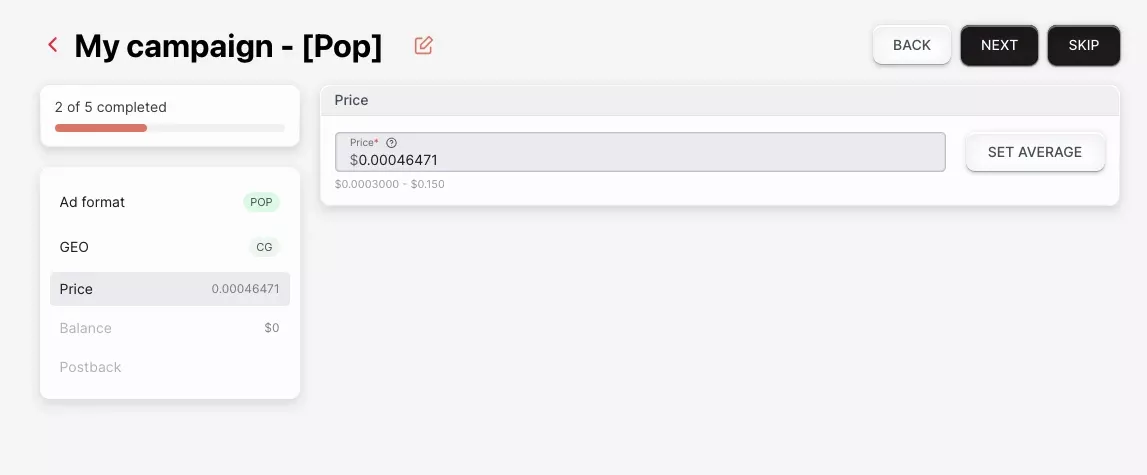
That balance covers enough clicks on cheap inventory to see whether a creative holds attention. Floors differ by format and come in two units - Pop, Push and In-Page Push run exclusively on CPC for self-serve users, while the other five formats are priced on CPM - and each floor marks where the bidding opens.
| Format | Model | Minimum bid |
|---|---|---|
| Pop / Popunder | CPC | $0.0003 |
| In-Page Push | CPC | $0.0008 |
| Push | CPC | $0.001 |
| Banner | CPM | $0.001 |
| Telegram Rewarded Post | CPM | $0.01 |
| Native | CPM | $0.1 |
| Video Pre-Roll | CPM | $0.1 |
| Telegram Rewarded Video | CPM | $0.1 |
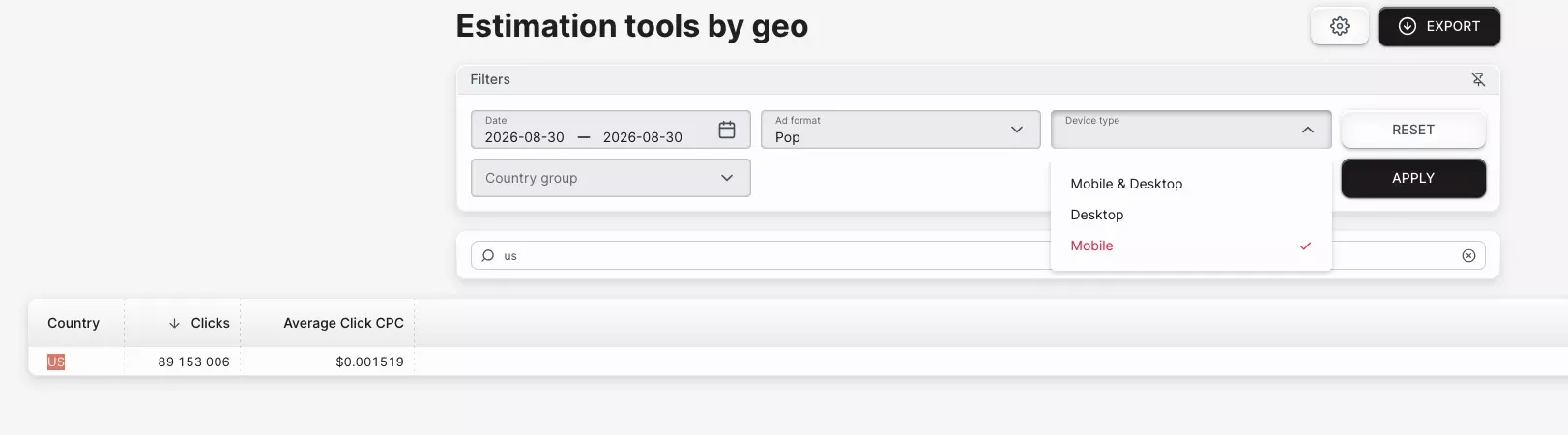
A floor is not a market price. Bidding the minimum on Pop launches a campaign that wins only the impressions nobody else wanted. Most networks publish average bids somewhere before you fund an account - here that is the Traffic Calculator, which shows average bids by GEO and format from completed auctions and opens after free registration, with no deposit required. Daily budgets, spend pacing and test sizing are set in the campaign itself; the advertiser basics page walks through them.
Which Ad Formats a Network Sells, and Which Ones Publishers Can Monetise
A network rarely offers the same format list to both sides, because some inventory is bought from a channel the network does not resell. AdsCompass sells eight formats to advertisers and lets publishers monetise six.
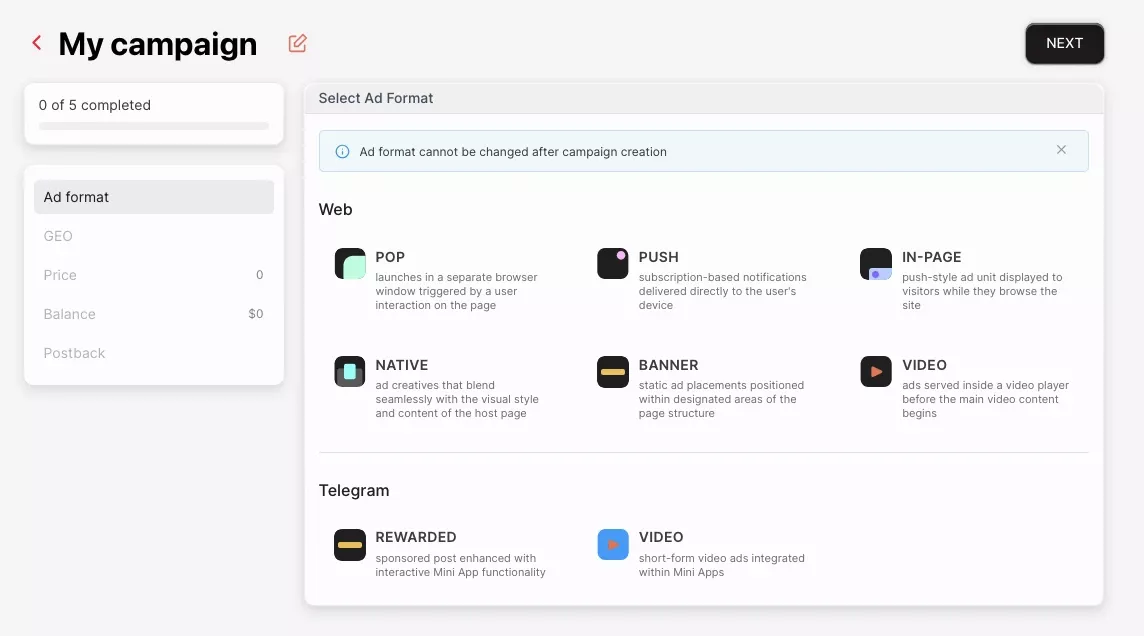
Format choice decides more than how the ad looks. It sets the pricing model, the floor price, the volume available and the moment the user is reached: a Pop opens a full screen of attention, push traffic arrives with the user's prior consent, a Native unit meets someone already reading on the topic. Each suits a different offer, which is why testing two formats with the same creative is usually more informative than testing two creatives on one.
| Format | What the user sees | Advertiser buys | Publisher monetized |
|---|---|---|---|
| Push | A browser notification, delivered after the user subscribes to the site | Yes | Yes |
| In-Page Push | A notification-styled block rendered inside the page, with no subscription needed | Yes | Yes |
| Native | An image-and-headline unit styled to match the surrounding content | Yes | Yes |
| Pop / Popunder | A new tab or window opening behind or in front of the page after a click | Yes | Yes |
| Banner | A fixed image unit in a reserved position of the page layout | Yes | Yes |
| Video Pre-Roll | A video ad playing before the content the user came for | Yes | Yes |
| Telegram Rewarded Post | A Telegram post inside a Mini App, rewarded on interaction | Yes | No |
| Telegram Rewarded Video | A short video inside a Telegram Mini App, rewarded on completion | Yes | No |
Video inventory is delivered to players with VAST, the XML template that tells a player where to fetch the ad and how to report on it, so a video creative built once runs across compliant players anywhere.
The two Telegram formats were added in February 2025 and place ads inside Telegram Mini Apps. They are buy-side only: a publisher with a Telegram audience cannot monetise it through the publisher account at all, and that is a real limitation of the current setup.
How Ad Review Works and What Gets Rejected
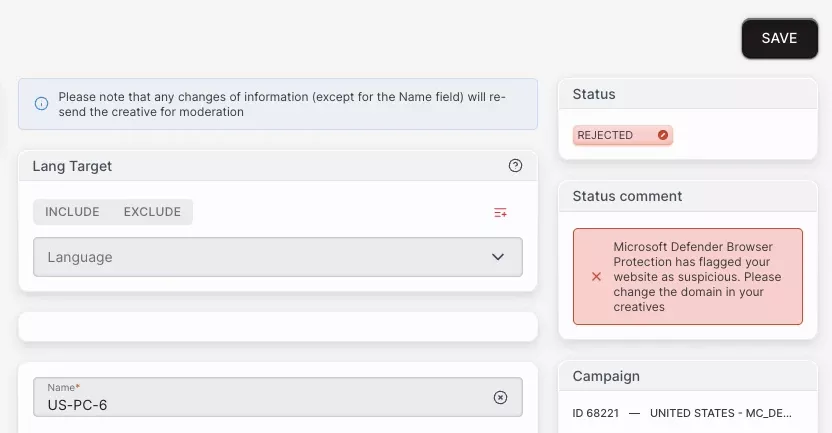
Every campaign is reviewed before it can enter the auction, because the network is liable for what appears on its publishers' sites. Review on AdsCompass usually finishes in about ten minutes. Adult and iGaming campaigns are allowed with restrictions; violence, weapons and drugs are refused.
Rejections cluster into three causes: a breach of a specific clause in the terms and conditions, a campaign link that does not resolve, and a destination URL carrying a large number of VirusTotal detections. The third catches people who did nothing wrong themselves - a domain bought with history, or a tracker domain on shared infrastructure, inherits someone else's detections.
How a Network Decides Which Ad to Show
A network matches each bid request against the campaigns in its system and auctions the impression among those that fit, so the winning ad is the highest bid from a campaign whose targeting matches that exact user.
The targeting filters that decide the match
Nine filters decide whether a campaign is eligible for a given impression on AdsCompass, and two of them are uncommon on self-serve platforms - IPv6 address exclusion and proxy connection exclusion, both of which cut a share of automated traffic before it reaches a budget.
- GEO - 200+ countries, plus city-level targeting
- Device, OS and OS version
- Browser and browser version
- ISP or mobile carrier
- Browser language
- Connection type
- Retargeting audiences
- IPv6 address exclusion
- Proxy connection exclusion
How the supply is screened before the auction
Every bid request reaching the auction comes from inventory that has already cleared two checks: individual premoderation of the publisher site before it is allowed to serve, and an antifraud layer that filters automated traffic out of the reporting continuously. Publishers reinforce this from their side with ads.txt and sellers with sellers.json, the two files buyers use to verify that a seller is authorised to sell the inventory it is offering.
What an advertiser gets to optimise with
Optimisation on this platform is manual, with no automatic conversion-goal bidding to reallocate budget for you - the clearest weakness against networks that ship one. The main tool is Source ID bidding, also called micro bidding: separate bid rules for individual source IDs, so the bid rises where conversion rate holds up and falls where click-through rate collapses, without pausing the campaign. Alongside it sit black and white lists on IP, ISP and source ID, a frequency cap per unique IP per day, dayparting with an explicit timezone, and a spend mode that runs evenly across 24 hours or as fast as the auction allows.
All of it depends on the source ID reaching your tracker. Conversions come back by S2S postback, and the available macros are campaign ID, creative ID, price, IP, source ID, user agent and click ID. Leave source ID out and the tracker will report that a campaign converted without saying which placements did.
How Much Traffic Sits Behind a Network
Network scale is counted in bid requests, not in visitors, and AdsCompass processes roughly 30 billion of them a day, serving about 900 million impressions and around 30 million clicks. Those figures are company estimates and have not been audited.
They describe a consistent funnel. Thirty billion requests producing 900 million impressions is a bid-to-impression ratio near 3% - often loosely called fill rate, though fill rate is normally measured against a publisher's own ad requests, not an exchange's outbound bid requests, so the two are not comparable. A ratio in that range is ordinary, because most bid requests arrive with no matching campaign and go unanswered.
Read the implied 3.3% click-through rate carefully. Popunder traffic dominates the mix, and a Pop "click" is an opened tab rather than a deliberate tap, so the blended figure sits far above what a push or banner campaign shows in reporting.
What a Publisher Connects, and How the Money Comes Back
A publisher connects by placing network code on a site and passing moderation, after which the inventory enters the same auction the advertisers bid into. The code takes one of three forms - a JavaScript tag, a direct link or a widget - and an open API with a personal token exposes the reporting programmatically.
Approval is individual. Sites are reviewed one by one and no visitor threshold is published, so a small site is judged on what its traffic is.
Money comes back on the schedule attached to the connection type: RTB publishers on Net30 counted from the invoice date, direct publishers on request from $50, which is also the minimum withdrawal. The publisher section lists the payment platforms.
How an Ad Network Differs From an Ad Exchange, a DSP, an SSP, an Ad Server and an Affiliate Network
An ad network aggregates inventory and resells it; the other five entities each own a different job in the same chain, and the labels are used interchangeably by people who mean different things.
| Entity | Whose side it is on | What it actually is |
|---|---|---|
| Ad network | Both, as the middleman | Aggregates supply, resells it to demand |
| Ad exchange | Neutral | The auction venue itself |
| DSP | Demand | The advertiser's buying console |
| SSP | Supply | The publisher's selling console |
| Ad server | Either | The system that stores creatives and delivers them |
| Affiliate network | Both, on a CPA basis | Connects offers to partners, paying per completed action |
An ad network owns the marketplace it operates. It decides which formats exist, what the bid floors are, which advertisers are admitted and how publisher supply is screened, then resells that supply packaged by targeting criteria.
An ad exchange is the marketplace where impressions are auctioned between many buyers and sellers at once. It does not own inventory or represent either side; it matches bids to bid requests and enforces the auction rules.
A DSP - demand-side platform - is the interface an advertiser uses to buy across multiple sources of supply, holding the targeting, budgets and bidding logic on the buyer's side.
An SSP - supply-side platform - is the mirror image on the publisher's side, connecting inventory to multiple sources of demand and maximising the price each impression receives.
An ad server is the system that stores creatives, decides which one to deliver against a booked line item, and counts the impressions and clicks. Networks, exchanges and publishers all run one.
An affiliate network connects offers to partners who are paid per completed action - a sale, a deposit, a registration. It sells outcomes; an ad network sells traffic priced per click or per thousand impressions.
Ad network vs affiliate network
The affiliate network is the one most often confused with an ad network, and the difference is what is being bought. An ad network sells impressions and clicks, and the risk of whether they convert stays with the advertiser. An affiliate network sells conversions, and the risk of whether traffic converts sits with the partner sending it.
In practice the labels blur, and AdsCompass is a clean example of why: the underlying ADMY Platform contains an SSP, a DSP and the auction in one system, while the Ad Exchange entry lets external SSPs and DSPs connect over RTB. A publisher in the dashboard is using an SSP, an advertiser in the self-serve account is using a DSP, and the auction between them is an exchange.
What an Ad Network Does Better Than Direct Deals, and Where It Loses
An ad network wins on reach and on the cost of getting started, and loses control over exactly where the ads appear.
What it does better:
- One integration and one balance covers 200+ countries; a direct deal covers one publisher.
- Entry is a deposit of tens of dollars; a direct deal starts with a signed insertion order and a minimum commitment.
- Pricing is set by auction each time, so it tracks demand instead of a rate card negotiated last quarter.
- Targeting, frequency capping and scheduling are set by the buyer, not agreed in advance with the site.
Where it loses:
- On blind supply, placements are identified by ID, so you optimise on identifiers and never see a list of site names.
- Traffic quality varies between sources, and the blacklists exist because you will need them.
- Automatic conversion-goal bidding is not universal - on this platform it does not exist.
- Publisher payouts on RTB terms are slower than the direct payouts a large site would negotiate for itself.
AdsCompass in Numbers
| Parameter | Value |
|---|---|
| Platform launched | 2013 |
| Auction type | First-price, OpenRTB |
| Minimum deposit | $50 |
| Lowest minimum bid | $0.0003 CPC (Pop) |
| Formats | 8 for advertisers, 6 for publishers |
| Pricing models on self-serve | CPC on Pop, Push, In-Page; CPM on the other five |
| Moderation time | About 10 minutes |
| GEO coverage | 200+ countries |
| Advertiser cashback | From 1% of spend, rising with turnover |
| Minimum publisher withdrawal | $50 |
| Publisher payout terms | Net30 from invoice date (RTB); on request from $50 (direct) |
FAQ