



RTB is one of those abbreviations that gets mentioned at every conference but that most market participants explain differently. Some equate RTB with programmatic, others consider it a separate buying format, and others are convinced it's only for enterprise budgets. In practice, RTB is an auction mechanism through which over 90% of global display ad spending flows. According to eMarketer projections, in 2026 programmatic channels powered by RTB process the overwhelming majority of all digital budgets. For ad networks like AdsCompass, RTB is one of two ways to work with partners, alongside the self-serve platform. This guide explains how RTB works at a mechanical level, how it differs from direct buying, why both sides of the market need it, and when self-serve is the better choice.
Key Takeaways
- RTB is a real-time auction where each impression is sold individually in 50–100 milliseconds
- RTB is part of programmatic, but not all programmatic runs through RTB
- SSP sells the publisher's inventory, DSP buys it for the advertiser
- AdsCompass operates as both SSP and DSP, connecting partners via oRTB, XML, and JSON
- RTB requires technical integration — for getting started without integration, self-serve is the way
What Is RTB in Simple Terms
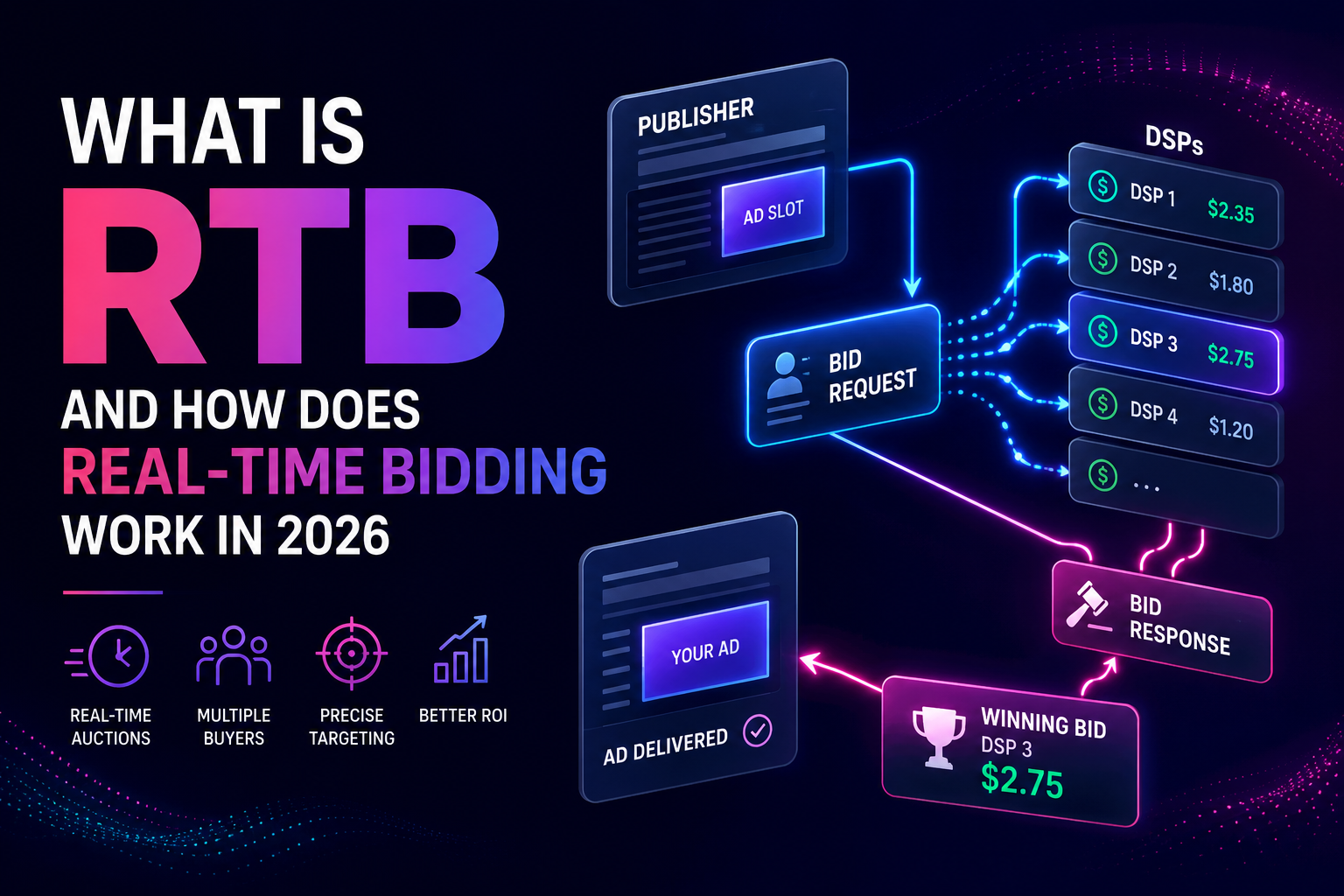
Real-Time Bidding (RTB) is a method of buying and selling ad impressions through a real-time auction. When a user visits a website, the ad platform sends information about the available impression (who the user is, what device they're on, where they're from) to all connected advertisers within a fraction of a second. Advertisers automatically place bids, and the one who offers the most wins the auction — their ad is displayed. The entire process takes 50–100 milliseconds: the user notices no delay, while the advertiser and publisher get the optimal price for each specific impression. Before RTB, advertising was sold in packages: a publisher would agree with an advertiser on a fixed rate per 1,000 impressions, and the budget was spent regardless of how valuable each individual user was. RTB replaced this model with dynamic pricing, where each impression is evaluated individually. According to Statista, the global RTB market grew from $21 billion in 2025 to $26.3 billion in 2026 — a 25% increase in a single year.
How the RTB Auction Works: Step-by-Step Mechanics
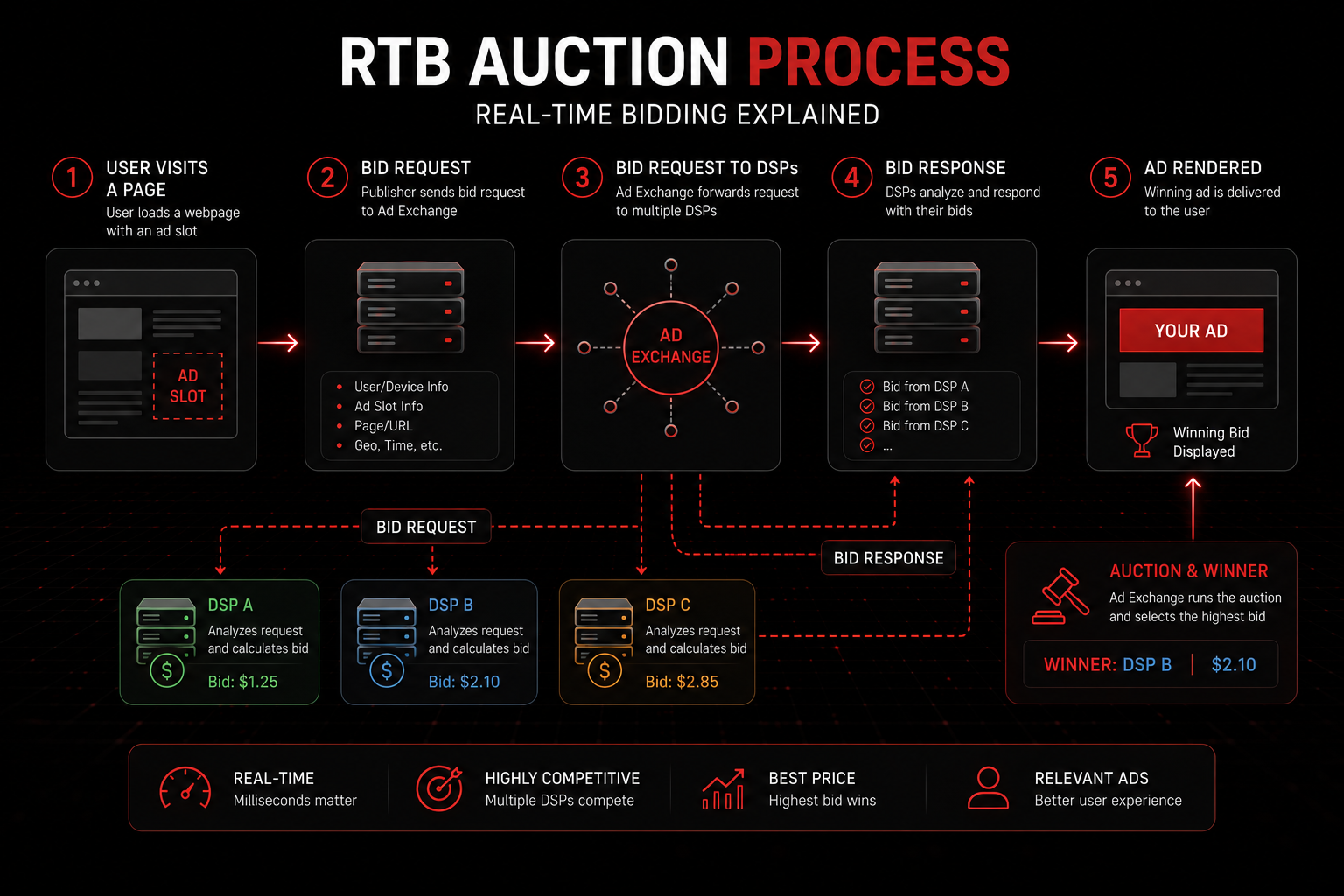
An RTB auction is an automated process involving three parties: the publisher (via SSP), the advertiser (via DSP), and the ad exchange as the venue where the auction takes place. The entire chain completes during page load — the user sees the ad simultaneously with the content. The OpenRTB protocol, developed by IAB Tech Lab, standardizes data exchange between all participants and ensures cross-platform compatibility. In 2026, virtually all RTB auctions operate on a first-price model: the winner pays exactly the amount they bid, with no downward adjustment.
Bid Request: The Impression Request
A user visits the publisher's website. The SSP (Supply-Side Platform) generates a bid request — a request containing information about the impression: page URL, user GEO, device type, OS, ad unit format. The bid request is sent to the ad exchange and from there to all connected DSPs.
Bid Response: The Advertiser's Bid
Each DSP (Demand-Side Platform) receives the bid request and decides within milliseconds whether to participate in the auction and what bid to offer. The decision is made by an algorithm based on user data, campaign budget, targeting, and historical performance. The DSP sends a bid response — a reply containing the bid amount and creative.
Auction Winner and Ad Display
The ad exchange compares all received bids and determines the winner. The winning advertiser's ad is shown to the user. The publisher receives payment for the impression, and the advertiser gets contact with the target audience. The entire process — from bid request to ad render — completes in 50–100 milliseconds.
How Does RTB Differ from Direct Buying?
Direct buying is a model where the advertiser negotiates with the network or publisher directly: a fixed rate, a chosen format, specific GEOs. On AdsCompass, direct buying happens through the self-serve advertiser dashboard: the buyer creates a campaign, sets targeting, establishes CPC or CPM, and launches. They control every parameter manually.
RTB works differently: pricing is dynamic, decisions are made by algorithms rather than manually. The advertiser sets rules (maximum bid, targeting, budget), and the DSP automatically participates in auctions for each individual impression. This allows buying only those impressions that match the criteria and paying market price rather than a fixed rate.
When to choose direct buying: you're starting with an ad network, budget is under $500, you need full manual control, and there's no technical capability for integration. When to choose RTB: you're working with large volumes, you have a DSP or a technical team for integration, and you need access to inventory beyond a single network.
What Are SSP and DSP and What Role Do They Play
SSP and DSP are the two sides of an RTB auction. An SSP (Supply-Side Platform) is the platform on the publisher's side. It receives ad inventory from publishers, forms bid requests, and sends them to the ad exchange. The SSP's job is to sell each impression at the highest price by ensuring competition among advertisers.
A DSP (Demand-Side Platform) is the platform on the advertiser's side. It receives bid requests, evaluates each impression against set criteria, and places bids. The DSP's job is to buy the right impressions at the optimal price.
Between them sits the ad exchange: the venue where the auction takes place. An ad network can act simultaneously as an SSP (selling its publishers' inventory) and as a DSP (buying traffic for its advertisers). AdsCompass works exactly this way: connecting to partners as both SSP and DSP through oRTB, XML, and JSON integrations — as described on the about us page.
Why RTB Matters for Advertisers and Publishers
RTB isn't a replacement for self-serve — it's an expansion of capabilities. For both sides of the market, RTB solves tasks that direct buying doesn't cover. But the mechanics of the benefit work differently for each: the advertiser gains access to more inventory, the publisher gains access to more advertisers. The result for both is more efficient pricing.
For Advertisers: Access to Inventory Beyond Self-Serve
Through RTB, an advertiser buys impressions not just within a single ad network but also from connected partners. This increases reach and allows finding audiences where self-serve can't reach. For large teams working with their own DSP, RTB is the standard buying method: set the rules, the algorithm buys. On AdsCompass, RTB integration for advertisers is available via oRTB and XML feeds.
For Publishers: More Competition for Your Traffic
For publishers, RTB means their inventory is competed for not just by advertisers within one network but also by external DSPs connected via RTB. More buyers at auction means higher bids means higher eCPM. On AdsCompass for publishers, direct demand from 6,500+ advertisers is supplemented by RTB demand from external partners. More details on integration capabilities are available in our official thread on affLIFT.
When RTB Doesn't Fit: Honest Tradeoffs
RTB is a powerful tool, but not a universal one. There are situations where self-serve works better, and that's fine.
The first limitation: technical integration. RTB requires connecting via the oRTB protocol, XML, or JSON. For a team without technical resources, this is a barrier. The AdsCompass self-serve dashboard lets you launch a campaign in 10 minutes with no integration — for getting started, that's enough.
The second: price unpredictability. In RTB, the bid is determined by auction, and during peak periods (Q4, major sporting events) prices can spike sharply. On self-serve, you control CPC/CPM manually and don't depend on auction competition.
The third: latency. An RTB auction takes 50–100 ms, and if the SSP or DSP responds slowly, the impression is lost. At large volumes, even 1–2% losses from timeouts affect fill rate.
The fourth: for small budgets, RTB is overkill. If you're spending 200–500 per month and working with one network, self-serve covers all needs. RTB makes sense when volumes require automation and access to inventory beyond a single platform.
How RTB Works on AdsCompass
AdsCompass provides two ways to work with the platform: self-serve for independent campaign management and RTB for programmatic integrations with partners. The platform connects as both SSP and DSP, using oRTB, XML, and JSON protocols. This means external DSPs can buy AdsCompass inventory through the RTB auction, and external SSPs can sell their inventory to AdsCompass advertisers.
For advertisers working through self-serve, RTB happens "under the hood": AdsCompass's internal auction determines which ad is shown on each zone, ensuring competition among advertisers and optimal rates for publishers. For partners connecting programmatically, RTB opens access to 900 million+ daily impressions across 200+ GEOs and a full set of formats: pop, push, in-page, native, banners, video pre-roll, and Telegram Mini-App.
A proprietary anti-fraud system filters invalid traffic before the auction, protecting both sides. To get started — sign up on the platform for self-serve access, or contact the team via the about us page to set up an RTB integration.
FAQ
How does RTB differ from programmatic advertising?
Programmatic is the umbrella term for automated buying and selling of advertising. RTB is one programmatic method, based on a real-time auction. Other methods include Programmatic Guaranteed (fixed price, no auction) and Private Marketplace (auction with a limited number of participants). RTB is the most common: over 60% of all programmatic transactions in 2026.
How long does an RTB auction last?
50–100 milliseconds — from bid request to ad display. The user notices no delay: the ad loads simultaneously with the page content.
Is technical integration required to work with RTB?
Yes. RTB requires connecting via the oRTB protocol, XML, or JSON. This is a task for a technical team. If integration isn't possible, AdsCompass offers a self-serve dashboard that requires no technical setup and lets you launch a campaign in minutes.
What is a first-price auction?
In a first-price auction, the winner pays exactly the amount they bid. In 2026, this is the RTB standard. Previously, second-price auctions were used, where the winner paid 0.01 more than the second-highest bid — this model is no longer applied on open exchanges.
Can RTB and self-serve be used simultaneously?
Yes. On AdsCompass, an advertiser can manage campaigns through the self-serve dashboard while also connecting an RTB integration for programmatic buying. A publisher can receive demand from both direct self-serve advertisers and external DSPs via RTB.
Is RTB suitable for small advertisers?
For budgets under 500/month, RTB is typically overkill: self-serve provides full control without technical integration. RTB makes sense when volumes require automation, or when access to inventory beyond a single ad network is needed.
About the Author
Vlada, Business Developer at AdsCompass. Works with advertisers and publishers in digital advertising, specializing in performance formats and international markets. Helps partners build traffic acquisition and monetization strategies across 200+ GEOs.