



Scaling is the stage where most campaigns break. A test shows +50% ROI, the buyer triples the budget — and ROI drops to –10%. A familiar story. I see it regularly at AdsCompass: a campaign that was consistently earning $30–40 profit at $20/day stops working at $100/day. The cause isn't the traffic or the platform — the cause is how the campaign is being scaled. Increasing the budget isn't scaling. Scaling is a managed expansion process where every step is backed by data and every new budget level is verified before moving to the next. This guide is a specific algorithm: how to go from the first profitable test to stable revenue without losing ROI along the way.
Key Takeaways
- Scaling almost always lowers ROI initially — this is normal, not a reason to panic
- Horizontal scaling (new GEOs, formats) is safer than vertical (increasing budget)
- Increase budget by no more than 30–50% per step, with 48–72 hours for stabilization
- A whitelist working at $20/day may not hold at $100/day — competition for zones increases
- The RON campaign must run continuously as a source of new zones for whitelist expansion
Why Scaling Lowers ROI and How to Prepare
The first thing to accept: scaling and ROI are inversely related at the initial stage. This isn't a bug — it's market mechanics. When a campaign runs at $20/day with a whitelist of 15 zones, every click comes from a verified source. When the budget grows to $100/day, those same 15 zones don't have enough volume, and the campaign starts pulling traffic from less verified sources — either by raising the bid (making clicks more expensive) or by expanding to new zones (lowering CR). Both options temporarily reduce ROI. According to Statista, global digital ad spending grows 10–12% annually, and competition for quality inventory is intensifying. Scaling in 2026 isn't "more budget → more profit" — it's "more budget → more tests → new working setups → more profit."
Preparation: before scaling, record baseline metrics of the current campaign — CPA, CR, CTR, ROI by zone. This is your anchor: if after any scaling step metrics deviate from baseline by more than 30% — stop, analyze, adjust. Without a baseline, you won't know whether scaling worsened the result or an external factor did.
Vertical vs Horizontal Scaling: What's the Difference
Two approaches to growth, each with its own mechanics and risks. Understanding the difference determines which path to choose at each stage. Per IAB standards, diversification of sources and formats is a baseline risk-reduction strategy in performance marketing. Practice shows that combining both approaches delivers the best result: vertical scaling to the ceiling, then horizontal expansion.
Vertical: Increasing Budget on a Working Campaign
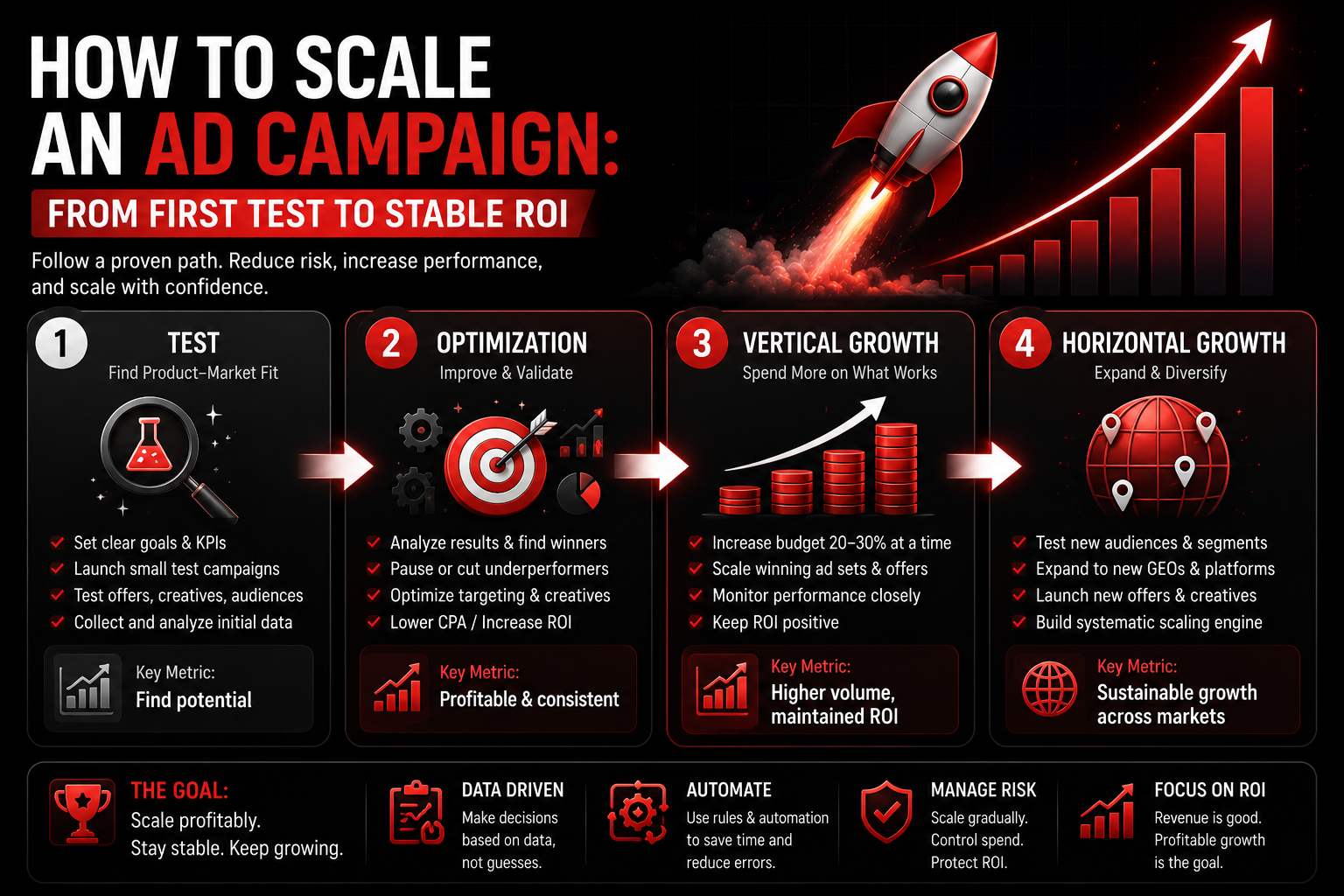
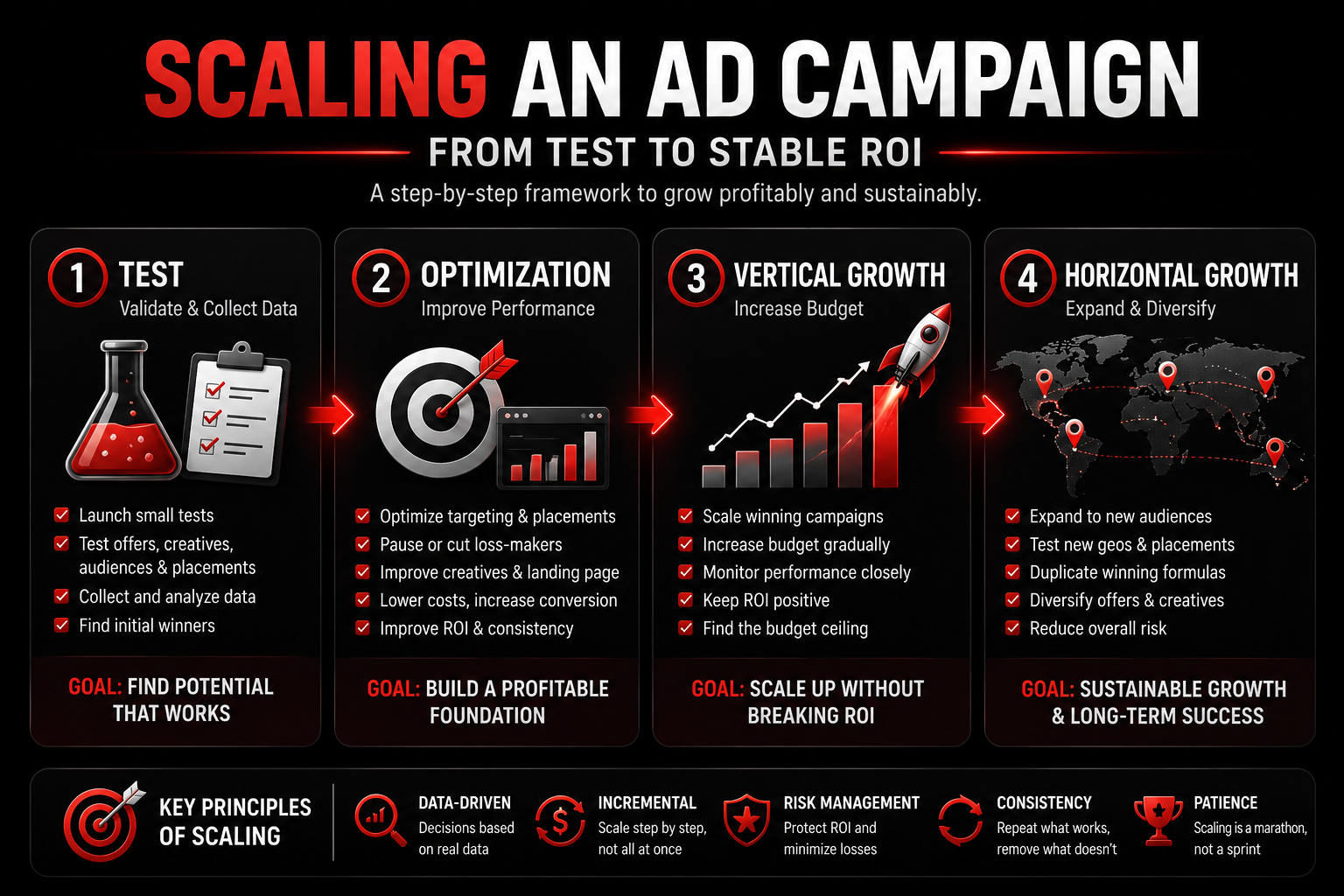
Vertical scaling is budget growth on the same setup: same GEO, same format, same zones. The fastest method, but with a hard ceiling. The ceiling arrives when whitelist zones exhaust their volume: each additional dollar buys increasingly lower-quality traffic. The ceiling signal: CPA rises for 3 consecutive days at an unchanged budget. This means whitelist zones are already delivering their maximum, and further budget increases only raise the bid without increasing conversions.
Horizontal: Adding New GEOs, Formats, and Devices
Horizontal scaling is expansion into new markets, formats, or device types. Each new direction is a separate test that starts with a RON campaign and goes through the full optimization cycle. Slower than vertical, but with no ceiling: AdsCompass covers 200+ GEOs and provides a full set of formats, offering virtually unlimited horizontal growth potential.
When a Campaign Is Ready for Scaling
Not every profitable campaign is ready for scaling. One conversion with +200% ROI is a fluke, not a scaling signal. Specific thresholds after which scaling is justified: a minimum of 20–30 conversions per campaign. This is the statistical significance threshold — with fewer, CPA may be accidentally low. Stable CPA over 5–7 days. If CPA jumps from $5 to $20 day to day, the campaign isn't stable yet, and scaling will only amplify the volatility. ROI of at least +20–30% after deducting tracker cost and time. If ROI is +5% on the test, scaling will very likely push it into negative territory because new zones and GEOs will convert worse than proven ones.
A whitelist of at least 10–15 zones. If profit comes from 3 zones, there's nowhere to scale: increasing budget on 3 zones will quickly hit a volume ceiling.
How to Scale Through Whitelists and New GEOs
A step-by-step process that works for CPC campaigns on AdsCompass. Step one: increase the current whitelist campaign budget by 30–50%. Not 100%, not 200% — gradual growth gives zones time to adapt and shows whether there's remaining volume. Allow 48–72 hours for stabilization. If CPA stays within +20% of baseline — repeat. If CPA grows by 30%+ — you've hit the ceiling, move to horizontal.
Step two: simultaneously expand the whitelist through the RON campaign. RON with a black-list continues running as a discovery channel. New converting zones get added to the whitelist campaign, increasing its capacity. The more zones in the whitelist, the higher the vertical scaling ceiling.
Step three: add new GEOs. Choose GEOs from the same region as the working one: if Indonesia converts, test the Philippines, Vietnam, Thailand. The audience is similar, behavior is comparable, and the landing page may need minimal localization. For each new GEO — a separate RON campaign, a separate optimization cycle, a separate whitelist. On AdsCompass, each campaign is configured for a specific GEO with its own bids and lists.
How to Add Formats When Scaling
Adding a format is one of the most effective horizontal scaling methods. Each format monetizes a different interaction type and reaches a different audience segment. But each format is a separate campaign requiring separate testing.
Recommended order of addition for a CPC buyer. Start with pop: maximum volume, minimum cost, fast data collection. Second format — push: subscriber audience, high CTR, predictable conversion. Third — in-page push: iOS coverage and users without push subscriptions. Fourth — native (CPM): when CPC formats are already optimized and additional volume with a different contact type is needed.
Each new format launches in the same GEOs where the previous one is already running — this provides a comparable baseline. Through a tracker (Voluum, Keitaro, Binom), you see cost per conversion by each format separately and can reallocate budget to the leader. All AdsCompass formats launch from one self-serve dashboard — no additional integrations required.
What Mistakes Kill ROI When Scaling
The first and most expensive: increasing budget 2–3x in a single step. With a sharp increase, whitelist zones can't deliver proportionally more volume, the campaign pulls traffic from suboptimal sources, and CPA spikes. Maximum is 30–50% per step with 48–72 hours for stabilization.
The second: scaling without RON. If the whitelist campaign is running but RON is stopped, no new zones are coming in. The whitelist gradually burns out over time: zones lose volume, competition for them grows, CPA rises. RON is a permanent source of fresh zones.
The third: copying settings from one GEO to another. Indonesia and Brazil are two different markets. Bids, behavior, conversion, landing page, peak activity hours — everything differs. Each new GEO is a separate test from scratch, not a copy of the existing campaign.
The fourth: scaling an unprofitable campaign. "I'll increase the budget — CPA will drop due to volume" — no. If a campaign is unprofitable at $20/day, at $100/day it will be unprofitable 5 times faster. Only profitable, stable campaigns with confirmed ROI should be scaled.
The fifth: ignoring frequency caps when growing budget. Increasing budget without proportionally expanding the whitelist leads to the same users seeing ads more often. The frequency cap should remain at the same level, and budget growth should be offset by growth in the number of zones.
How to Scale Campaigns on AdsCompass
AdsCompass is built for scaling: 200+ GEOs, a full set of formats (pop, push, in-page, native, banners, pre-roll, TMA), CPC and CPM models — all from one [self-serve dashboard](https://adscompass.com/advertisersFor tracking — S2S postback integrations with Keitaro, Binom, RedTrack, Voluum, BeMob. The zone_id subID parameter passes zone data to the tracker, enabling white/black-lists built on conversions rather than clicks. More on tracking, zone optimization, and campaign setup is available on the AdsCompass blog.). For horizontal scaling, no separate integrations are needed for each market or format. Each campaign is configured individually: its own GEO, format, budget, white/black-lists, frequency cap, and dayparting. Real-time statistics by zone, device, and OS allow controlling ROI at every stage of growth.
The platform processes over 900 million impressions daily — volumes sufficient for scaling campaigns of any size. For publishers, growing advertiser budgets mean stronger competition for inventory and, consequently, higher eCPM. To get started — sign up and launch your first test.
Scaling algorithm: profitable test (20+ conversions, ROI +20%) → vertical scaling (+30–50% budget, 48h stabilization) → whitelist expansion via RON → horizontal scaling (new GEOs in the same region) → format addition (push to pop, in-page to push) → repeat.
FAQ
How much can I increase the budget at once?
30–50% is the safe step. After increasing, give the campaign 48–72 hours to stabilize. If CPA stays within +20% of baseline — repeat. A 100%+ budget increase in a single step almost always breaks the campaign.
Does scaling always lower ROI?
At the initial stage — almost always. New zones, GEOs, and formats are unoptimized and convert worse than proven ones. This is normal. The task is to bring ROI back to baseline through optimization (white/black-lists, bids, creatives) and hold it at the new budget level.
When should I add a second format?
When the first format is optimized and stable: whitelist is formed, CPA is stable for 5–7 days, ROI is positive. Add the second format in the same GEOs — this provides a comparable baseline for evaluating effectiveness.
How to scale into a new GEO without wasting budget?
Launch a separate RON campaign in the new GEO with a daily limit of $10–20. Allow 48–72 hours for data collection. Build a black-list, then a whitelist. Only after forming a whitelist of 10+ zones should you begin scaling. Don't copy settings from another GEO — test from scratch.
Can I scale a campaign with 10% ROI?
Risky. During scaling, ROI temporarily drops by 15–30%. If the starting ROI is 10%, after scaling it may go negative. The recommended threshold for scaling is a minimum +20–30% ROI, with a buffer for the temporary decline.
How long does scaling take from test to stable revenue?
Depends on GEO and format. Benchmark for one GEO + one format: 1–2 weeks for testing and optimization, 2–3 weeks for vertical scaling, 2–4 weeks for adding GEOs. Total: 5–9 weeks from first launch to stable scale. Horizontal scaling across multiple GEOs and formats takes 2–3 months.
About the Author
Vlada, Business Developer at AdsCompass. Works with advertisers and publishers in digital advertising, specializing in performance formats and international markets. Helps partners build traffic acquisition and monetization strategies across 200+ GEOs.