



The digital advertising market in 2026 consists of hundreds of ad networks, each calling itself "the best." Lists of "top 10 ad networks" get published monthly, but most are promotional materials written by the networks themselves or their affiliates. For an advertiser or publisher, that's not very useful: what's needed isn't a ranking but a framework — a set of criteria for evaluating any platform against your specific objectives. I work at AdsCompass and speak with both sides of the market daily: buyers looking for traffic and publishers looking for demand. Their selection criteria are different, but the mistakes are the same. This guide isn't a list of "best networks." It's a practical checklist: what to verify, what to ask about, and which signs should make you close the tab.
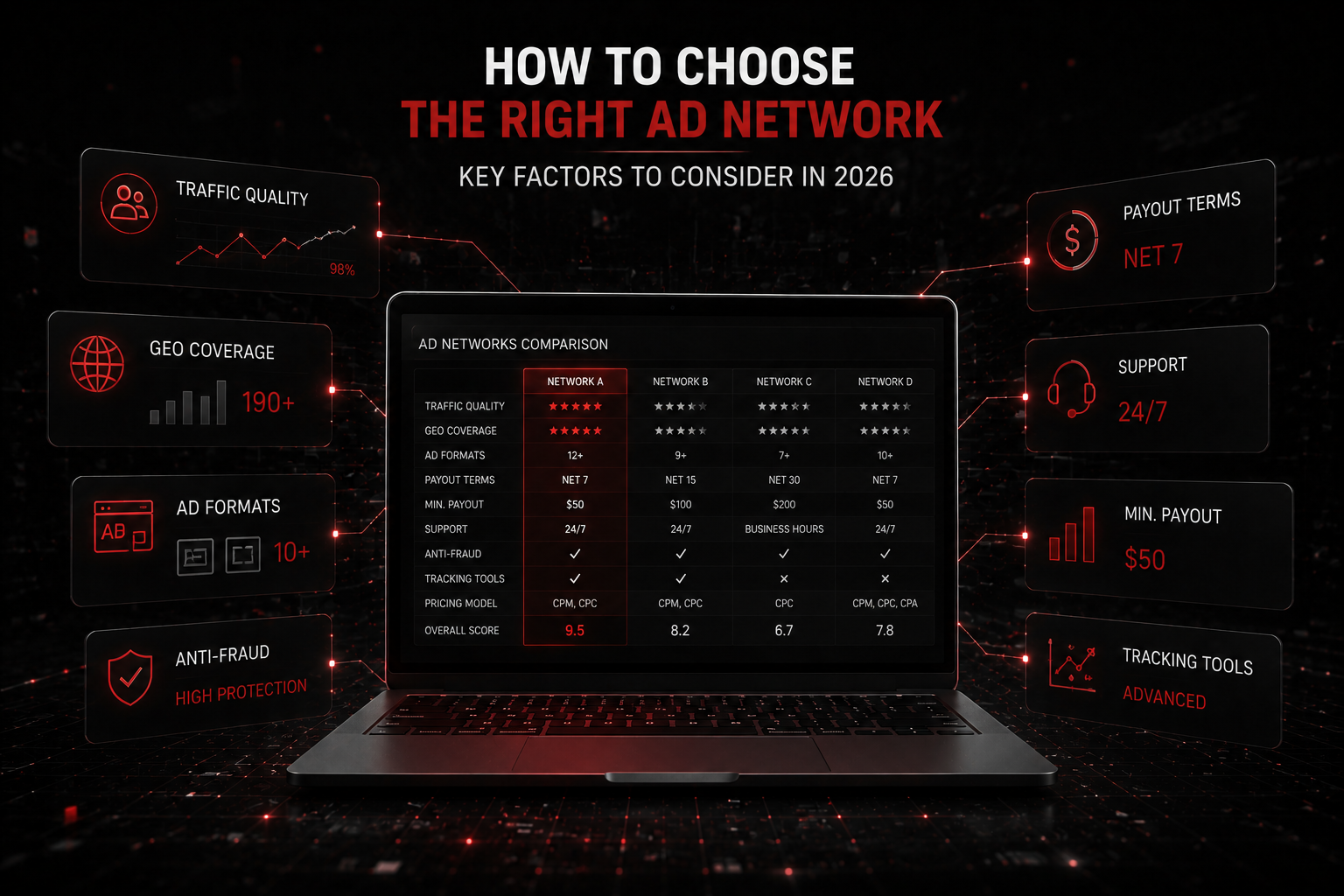
- Advertisers and publishers need different criteria when choosing a network
- Direct publishers deliver better traffic quality than aggregated inventory
- Platform-level anti-fraud is a baseline requirement, not a competitive advantage
- Self-serve gives control but requires expertise to be effective
- Guaranteed results and "best rates on the market" are red flags, not advantages
Why "Top 10 Network" Lists Don't Help You Choose
Most ad network rankings follow the same template: a brief description of each platform, a couple of screenshots, generic phrases about "large volumes" and "quality traffic." The problem is that these lists don't provide criteria for making a decision. A network that works brilliantly for push campaigns in Tier-3 may be useless for native in Tier-1 — but in a ranking, both sit side by side. According to Statista, global digital advertising spend exceeded $627 billion in 2026, and those budgets are distributed across hundreds of platforms with fundamentally different models, formats, and audiences. Choosing between them by listicle is like choosing a car by color. The right approach: define your objectives (format, GEO, budget, pricing model), then evaluate each network against specific criteria. Below are those criteria, separated for advertisers and publishers.
What Should Advertisers Look for When Choosing a Network?
An advertiser pays money and expects results: clicks, conversions, return on spend. But between the deposit and ROI sits the platform that determines where every cent goes. The criteria below are listed in priority order — from what makes a network not worth considering at all, to what separates a good network from a great one. Per IAB standards, inventory transparency and source verifiability are baseline requirements for any advertising platform.
Volumes and GEO Coverage
The first question: does the network have real volumes in the GEOs you need. "200+ countries" in the description doesn't mean there's traffic in each one. Verify through a Traffic Calculator or Estimation Tools if they're available before launch. On AdsCompass, this tool is accessible in the advertiser dashboard after registration — you can see current volumes and rates for each GEO and format before funding your balance.
Formats and Pricing Models
The network should support the formats you need and pricing models that fit your objectives. CPC (pop, push, in-page) — you pay per click and control the cost of each interaction. CPM (native, banners, video pre-roll) — you pay per impression and work on reach. If the network offers only one model — that's a limitation. A full stack of formats in one dashboard lets you test and compare channels without switching between platforms.
Traffic Quality and Anti-Fraud
Having a proprietary anti-fraud system in 2026 isn't an advantage — it's a minimum requirement. Per TAG recommendations, platform-side traffic verification is mandatory practice for all market participants. Ask the network how exactly their filtering works: pre-bid, post-bid, or both. Find out whether the network works with direct publishers or aggregates traffic through intermediaries. Direct sources mean fewer links in the chain and less risk of fraud and inventory spoofing.
Targeting and Optimization Tools
Basic targeting (GEO, device, OS) exists everywhere. The difference lies in optimization tools: zone-level white- and black-lists, frequency caps, dayparting, real-time statistics with source-level breakdowns. Without these tools, optimization comes down to "turn campaign on/off" — and that's a path to wasted budget.
What Should Publishers Look for When Choosing a Network?
A publisher provides their traffic and wants maximum revenue with minimal damage to user experience. Selection criteria here are different: not "how much does a click cost" but "how much will I be paid for my traffic" and "how reliable is it."
Demand Quality and Fill Rate
The primary criterion for a publisher isn't the rate — it's eCPM: actual revenue per thousand requests, factoring in fill rate. A network can promise 5 CPM, but if the fill rate is 30%, the real eCPM is 1.50. Direct advertisers on the platform side create auction competition and, consequently, higher bids. On AdsCompass for publishers, direct demand from 6,500+ active advertisers creates competition for inventory, keeping eCPM at a stable level.
Payout Terms
Minimum withdrawal amount, payout frequency, available methods — all of these affect cash flow. A 500 minimum threshold for a small publisher means they won't see money for several months. A 50 threshold — within a few weeks. Also pay attention to payout guarantees: does the network delay payments, are there deductions for "low-quality traffic" without transparent explanation.
Statistics Transparency
A publisher should see eCPM, fill rate, and revenue by zone in real time — not once a week in a summary report. Without granular statistics, placement optimization is impossible: you don't know which zone earns more, which format performs better, and where fill rate is dropping.
Self-Serve or Managed Service: Which to Choose?
A self-serve platform gives full control: you create campaigns, manage bids, and optimize zones yourself. It's faster (no waiting for a manager), more transparent (you see all the data), and cheaper (no management markup). But self-serve requires expertise: a beginner without experience can drain a budget faster than a manager could intervene.
Managed service means a network manager sets up and optimizes campaigns for you. This is convenient for teams without media buying expertise or for large budgets where the cost of mistakes is high. The downside: less control, slower iterations, and often a markup on traffic.
The optimal model in 2026 is a hybrid: a self-serve platform with access to a support team. AdsCompass works exactly this way: a full self-serve dashboard for independent operation, plus a team of managers who help at every stage — from first launch to scaling.
What Red Flags Should Raise Concern
Over years of working in the industry, I've compiled a consistent list of signs that say "walk away" louder than any promotional copy. The first and most important: guaranteed results. "We guarantee 300% ROI," "our clients earn 10,000 per month" — no honest network writes this. Results depend on dozens of variables, and promising them in advance is impossible.
The second: no information about anti-fraud. If the network can't explain how it filters traffic — it most likely doesn't.
The third: non-transparent payout deductions for publishers. "Your traffic didn't pass quality checks" without specific data (which zones, which metrics, what threshold) is a reason to look for another network.
The fourth: no real-time statistics. If data updates once a day or less — you can't react to problems in time, and the network isn't interested in transparency.
The fifth: "best rates on the market" with no way to verify. Any network can write this on their website. The real check is a Traffic Calculator or a test launch with minimal budget.
How AdsCompass Meets These Criteria
AdsCompass is a self-serve platform operating since 2013, processing over 900 million impressions daily. Coverage spans 200+ GEOs with direct publisher integrations — not aggregated traffic through a chain of intermediaries. Full format stack: pop, push, in-page, native, banners, video pre-roll, and Telegram Mini-App — on CPC and CPM models. Proprietary anti-fraud system with pre-bid and post-bid filtering. For advertisers: 50 minimum deposit, Traffic Calculator for volume estimation before launch, white- and black-lists, real-time statistics, S2S postback integrations with Keitaro, Binom, RedTrack, Voluum, BeMob. For publishers: direct demand from 6,500+ advertisers, 50 minimum payout, withdrawal via PayPal, Crypto, Stripe, Paxum, WebMoney, Wire Transfer. A support team is available at every stage — from first launch to scaling. We don't position ourselves as "the best network on the market" — we position ourselves as a platform that covers all key criteria from a single dashboard.
FAQ
Can I work with multiple networks at the same time?
Yes, and many experienced buyers and publishers do exactly that. Advertisers test the same offer across several platforms, compare CR and CPA, and reallocate budget to the leader. Publishers connect multiple networks via waterfall or header bidding to maximize fill rate and eCPM.
What matters more — number of formats or quality of one?
It depends on the task. If you only work with push, a specialized network may offer better rates and volumes. If you need to test multiple channels and compare — a platform with a full format stack saves time and simplifies analytics. AdsCompass covers both scenarios.
How can I verify traffic quality before launching?
Run a test campaign with a minimal budget (20–50) for 24–48 hours. Check CTR, bounce rate, and CR by zone. Anomalies (CTR >5%, bounce rate >90%, zero CR at 500+ clicks) signal quality issues.
Why are direct publishers better than aggregated traffic?
Direct publishers are sources verified by the network at the onboarding stage. Fewer intermediaries = less risk of domain spoofing, GEO substitution, and bot traffic. Aggregated traffic is cheaper, but quality control is weaker and tracing a specific source is harder.
What minimum deposit is considered normal?
50–100 is the standard for self-serve platforms in 2026. If a network requires 500+ for a first launch, it's either a managed service with a markup or an attempt to lock you into the platform with a large deposit before you've evaluated quality.
Is S2S postback support mandatory?
For performance campaigns — yes. Without S2S postback, you see clicks but not which zones drive conversions. This makes optimization impossible. AdsCompass supports integrations with Voluum, Keitaro, Binom, RedTrack, and BeMob.
About the Author
Vlada, Business Developer at AdsCompass. Works with advertisers and publishers in digital advertising, specializing in performance formats and international markets. Helps partners build traffic acquisition and monetization strategies across 200+ GEOs.