



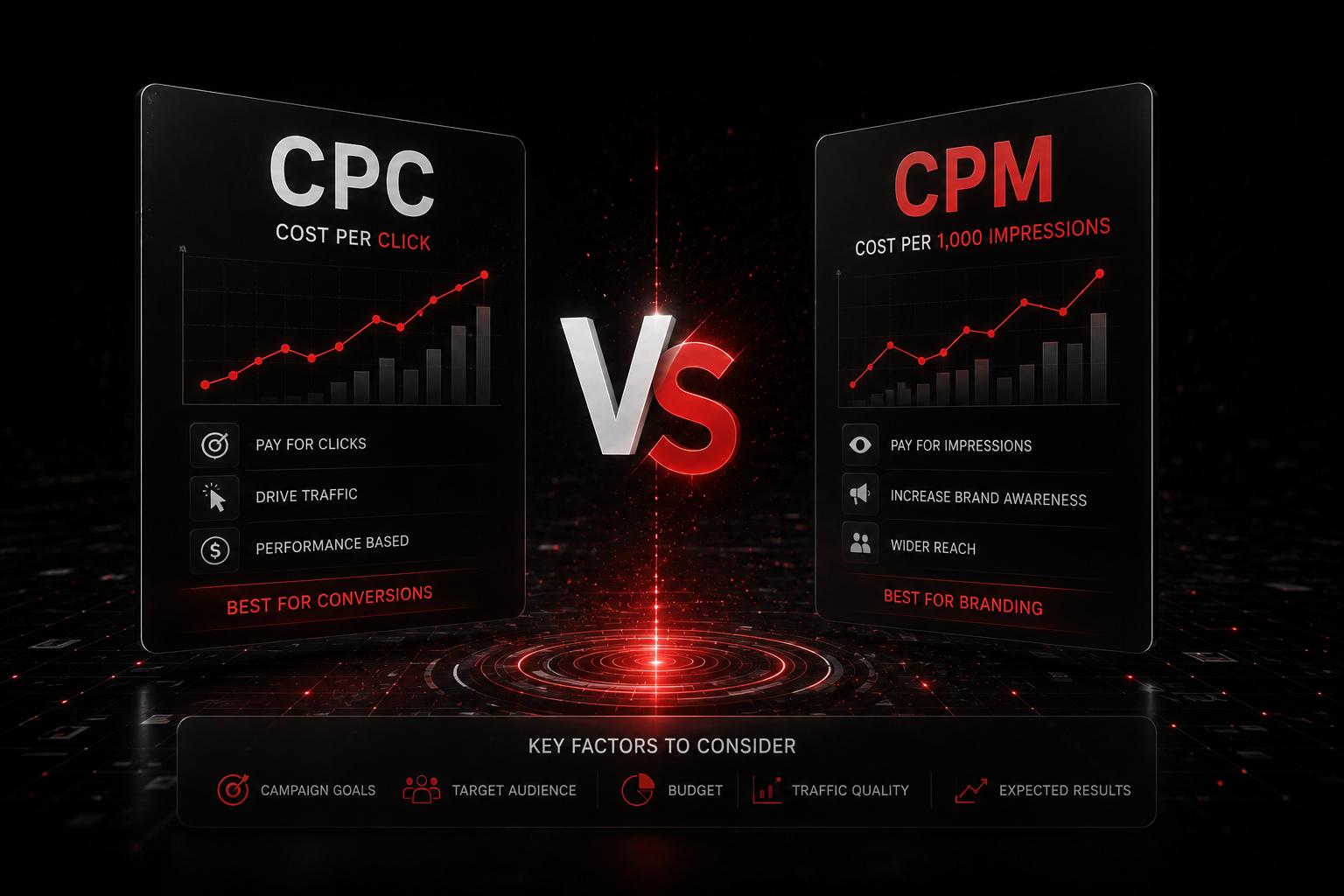
CPC and CPM are two foundational pricing models in digital advertising, and "which one is better" is one of the most common questions in the industry. The answer nobody likes: neither is better. Each solves a different problem, and the choice depends on the format, campaign objective, and which side of the platform you're on. An advertiser chooses a model to control spend. A publisher chooses a model to maximize revenue. Their logic is opposite — and that's normal. I work with both sides at AdsCompass and see how the same model can be ideal for a buyer and disadvantageous for a publisher on the same traffic. This guide explains the mechanics of both models, provides a formula for direct comparison, and ties each model to specific formats and objectives.
Key Takeaways
- CPC (pay per click) gives control over interaction cost, CPM (per 1,000 impressions) over reach cost
- On AdsCompass, pop, push, and in-page run on CPC; native, banners, pre-roll, and TMA run on CPM
- Comparison formula: eCPM = CPC × CTR × 1000
- CPC is safer for beginners, CPM is more profitable at high CTR
- For publishers, CPM means stable income, CPC means dependence on ad clickability
What Are CPC and CPM: The Actual Difference
CPC (Cost Per Click) is a model where the advertiser pays for each click on the ad. Money is charged only when a user interacts with the advertisement. If an ad is shown 10,000 times but clicked 100 times, the advertiser pays for 100 clicks. CPM (Cost Per Mille) is a model where the advertiser pays for every thousand impressions. Money is charged for the fact of display, regardless of whether the user clicked or not. According to IAB, both models remain the industry standard, but budget distribution between them shifts depending on format and campaign objective. In the context of ad networks running performance formats, the difference isn't abstract: it determines what exactly you're paying for and which risks you're taking on. CPC shifts the clickability risk to the publisher: if the ad doesn't get clicks, the advertiser doesn't pay. CPM shifts that risk to the advertiser: they pay for impressions even if CTR is zero.
When Is CPC More Profitable for an Advertiser?
CPC is the model for tasks where every click matters: performance campaigns, testing setups, collecting zone-level data. On AdsCompass, pop, push, and in-page run on CPC — three formats where user interaction with the ad is the key event. The advertiser pays only per click and controls the cost of each interaction. For a beginner, CPC is safer: you know exactly what one click costs and can calculate your budget in advance. At 0.01 CPC and a 50 budget, you'll get 5,000 clicks — predictable and manageable.
CPC is optimal in three scenarios. First: testing a new GEO or offer when you don't know the CTR and don't want to risk budget on impressions that won't lead to clicks. Second: performance campaigns with a clear CPA target — you control the top of the funnel (click cost) and optimize the bottom (post-click conversion). Third: working with white- and black-lists by zone — CPC lets you quickly identify which zones deliver clicks and which don't, and cut ineffective sources.
The limitation of CPC: if your creative or offer delivers high CTR, you may overpay. At 5% CTR and 0.05 CPC, you'll spend 2.50 per 1,000 impressions. On CPM, the same volume could cost $1.50. The verification formula is in the next section.
When Is CPM More Profitable for an Advertiser?
CPM is the model for tasks where reach and visibility matter: branding, awareness campaigns, working with formats where a click isn't the primary KPI. On AdsCompass, native, banners, video pre-roll, and Telegram Mini-App run on CPM. The advertiser pays for a guaranteed number of impressions and knows in advance what reach they'll get for their budget. According to Statista, the share of CPM budgets is growing in the video and native segment, where viewability and contact time matter more than clicks.
CPM is more profitable than CPC in two cases. First: you're confident in your creative's high CTR. At 3% CTR and 1.50 CPM, the effective cost per click is 0.05 — that's cheaper than 0.05 CPC at the same CTR, because on CPM you also get additional impressions that didn't convert to clicks but increased brand awareness. Second: you need a guaranteed volume of impressions for a fixed budget — for brand campaigns where the success metric is reach, not clicks.
The limitation of CPM: if CTR turns out to be low, you'll pay for impressions that didn't lead to interaction. A 2.00 CPM at 0.1% CTR means each click cost 2.00 — more expensive than most CPC rates in Tier-2/3.
How to Compare CPC and CPM Directly: The Conversion Formula
CPC and CPM measure different things, so comparing them directly isn't possible. But you can bring them to a common denominator through eCPM (effective CPM) — the actual cost of 1,000 impressions when running on CPC. The formula: eCPM = CPC × CTR × 1000. It shows how much you're actually spending per 1,000 impressions when working on a CPC model. If the eCPM comes out higher than the CPM rate for the same GEO, CPC is more expensive and it makes sense to switch to CPM. If lower, CPC is the better deal.
Example. A push campaign in a Tier-2 GEO: CPC 0.02, CTR 1.5%. eCPM = 0.02 × 1.5 × 1000 = 0.30. If CPM on similar traffic in native format costs 1.50, the CPC campaign on push is 5 times cheaper per 1,000 impressions. But if your creative's CTR rises to 5%: eCPM = 0.02 × 5 × 1000 = 1.00 — the gap narrows. At 10% CTR, eCPM = 2.00, and CPC becomes more expensive than CPM.
The takeaway: CPC is more profitable at low and medium CTR. CPM is more profitable at high CTR with a stable creative. The formula lets you calculate the exact switching point for a specific campaign.
What's More Profitable for a Publisher: CPC or CPM?
For publishers, the logic is reversed. On CPM, you earn for every impression regardless of whether the user clicked. This is stable, predictable income: if fill rate is high, you know how much you'll earn per thousand visits. On CPC, you earn only when a user clicks. Revenue depends on the advertiser's creative CTR, which you don't control. If the advertiser uploads a weak creative with 0.1% CTR, your eCPM drops to a minimum — even with large traffic volumes.
On AdsCompass for publishers, real-time eCPM statistics are available, letting you see which model earns more on specific zones. Practical recommendation: if your traffic consistently shows high CTR (above 1% on push), CPC may be more profitable because advertisers compete for clicks and drive up bids. If CTR is average or low, CPM provides a stable revenue base without dependence on clickability.
What Mistakes Are Made When Choosing a Pricing Model
The first and most common: choosing a model once and never revisiting it. CTR changes from creative to creative, GEO to GEO, season to season. A model that was profitable in January can become unprofitable in March. Recalculate eCPM every 2–4 weeks.
The second: comparing CPC and CPM without bringing them to a common denominator. "CPC 0.02 is cheaper than CPM 1.50" is a meaningless statement without CTR in the equation. Only eCPM makes the comparison valid.
The third: choosing CPM for tests. During the testing phase, you don't know CTR, which means you can't predict the real cost per click. CPC is safer: you pay only for actual interactions and collect data without risking budget on impressions with zero response.
The fourth: ignoring format. The pricing model is tied to format mechanics. Pop, push, and in-page are inherently click-driven — CPC is logical. Native and banners work on visual contact — CPM reflects their value more accurately.
How CPC and CPM Work on AdsCompass
AdsCompass is one of the few platforms where both models are available in a single self-serve dashboard. This matters: an advertiser can launch a push campaign on CPC, run native on CPM in parallel, and compare effectiveness through eCPM from one dashboard.
Model distribution across AdsCompass formats: CPC — pop, push, in-page. CPM — native, banners, video pre-roll, Telegram Mini-App (Rewarded Post and Rewarded Video). The platform covers 200+ GEOs and processes over 900 million impressions daily. Advertisers get access to the Traffic Calculator for rate and volume estimation before launch, white- and black-lists for optimization, and real-time statistics. Publishers get direct demand from 6,500+ advertisers, transparent eCPM and fill rate statistics, and a 50 minimum payout.
FAQ
Can I switch between CPC and CPM on one platform?
On AdsCompass — yes, but the model is tied to format: pop, push, and in-page run on CPC; native, banners, pre-roll, and TMA run on CPM. You can launch campaigns on both models simultaneously and compare results in one dashboard.
Which model is better for a first test?
CPC. During the testing phase, you don't know CTR, so you can't assess the real cost per impression on CPM. CPC gives control: you pay only for clicks and collect data for further decisions.
How do I calculate what I'll pay for 1,000 clicks on CPC?
Cost of 1,000 clicks = CPC × 1,000. At 0.02 CPC, that's 20. But the real question is how many impressions are needed for 1,000 clicks. At 1% CTR, you'll need 100,000 impressions. At 3% CTR — roughly 33,000.
Why is push sold on CPC while native is on CPM?
Format mechanics determine the model. Push is a notification whose value lies in the click: the user either taps it or swipes it away. Paying for a swipe-away is pointless — hence CPC. Native is an ad embedded in content: the user sees it even without clicking, and that alone has value for the advertiser (awareness). Hence CPM.
Does the pricing model affect traffic quality?
No, the pricing model is a billing method, not a quality filter. Traffic quality is determined by the platform's anti-fraud system, sources (direct publishers vs aggregated traffic), and targeting settings. On AdsCompass, anti-fraud operates identically for CPC and CPM campaigns.
What is eCPM and why do publishers need it?
eCPM (effective CPM) is the publisher's actual revenue per 1,000 server requests, accounting for fill rate and pricing model. It's the only metric that allows a valid comparison of CPC and CPM ad revenue on the same zone. A 5 CPM with 30% fill rate yields an eCPM of 1.50. A 0.03 CPC with 2% CTR yields an eCPM of 0.60. eCPM shows reality, not promises.
About the Author
Vlada, Business Developer at AdsCompass. Works with advertisers and publishers in digital advertising, specializing in performance formats and international markets. Helps partners build traffic acquisition and monetization strategies across 200+ GEOs.