



What Happened to Tier-1
Just two years ago, Tier-1 GEOs were considered the absolute benchmark for quality traffic. In 2026, the picture has changed: Tier-1 still delivers results, but its cost has grown to the point where more and more teams are reconsidering their strategy in favor of Tier-2 and Tier-3.
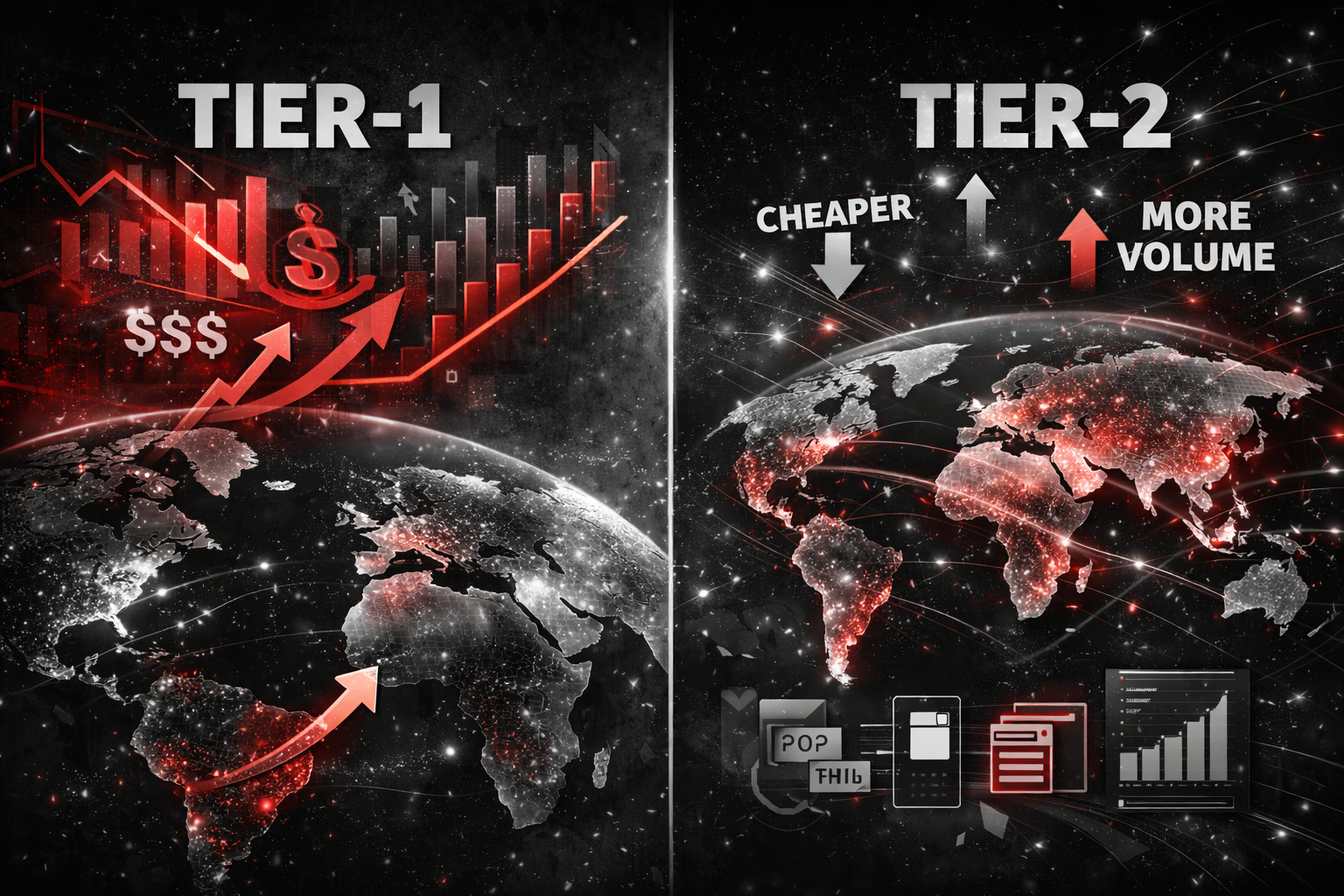
The main reason is auction overheating. Stricter moderation, narrower targeting options, and rising competition have made Tier-1 economics uncomfortable even for experienced teams. Tier-1 has not lost its high-paying audience. However, turning a campaign profitable now requires either a flawless creative or a budget that most media buyers are not willing to risk on a single test.
Why Tier-2 and Tier-3 Are a Separate Strategy
The perception of Tier-2 and Tier-3 as a "cheap substitute" is outdated. These are independent markets with their own logic, and when approached correctly, they solve problems that Tier-1 no longer can.
First, bid rates here are 2–5 times lower, which allows running significantly more tests within the same budget. In media buying, where iteration speed defines the final result, this is a key factor.
Second, auction competition is noticeably weaker — particularly in niche and non-English-speaking GEOs. Bids remain predictable, without sharp fluctuations.
Third, user behavior in these regions is characterized by a shorter path to conversion and a strong response to push, in-page, and pop formats — the very formats on which Adscompass traditionally has the largest volumes of Tier-2/3 traffic.
Priority GEOs for 2026
Adscompass operates across more than 200 GEOs, and based on our data, the following regions show the most stable performance in 2026:
Southeast Asia — Indonesia, Vietnam, the Philippines, Thailand, Malaysia. A large mobile audience and high engagement with push and in-page formats.
Latin America — Brazil, Mexico, Peru, Colombia. One of the most accessible regions for testing campaigns on the popunder format.
Africa — Nigeria, Kenya, Morocco, South Africa. The fastest-growing region in terms of mobile traffic over the past two years.
Eastern Europe — Poland, Romania, the Czech Republic. Quality Tier-2 with a high-paying audience and bid rates significantly lower than those in Germany.
How to Work with Tier-2 and Tier-3 Effectively
The main mistake when entering new markets is transferring creatives from Tier-1 without localization. This is not only about language: visual context, trust in imagery, and price perception all need to be taken into account. The only way to verify this is through testing.
The recommended approach is a broad launch across several GEOs within one region, rapid data collection, and subsequent optimization through white- and black-lists. At Adscompass, these tools are available on the self-serve platform, while the built-in anti-fraud system ensures traffic quality at the purchasing stage. For starting in Tier-2/3, pop and in-page push are the optimal formats: they deliver the required volume of data within a minimal timeframe and allow irrelevant zones to be filtered out quickly.
Devices deserve particular attention. In Asia and Africa, the Android share reaches 90%, making iOS targeting irrelevant in these regions. This should be factored in at the campaign setup stage.
Why Adscompass Fits a Tier-2/3 Strategy
Effective work with Tier-2 and Tier-3 requires a platform with real traffic volumes in these regions. Adscompass operates on CPC and CPM models, covers 200+ GEOs, and provides a full range of formats — pop, in-page, push, native, banner, video pre-roll, and Telegram mini-app. Direct integrations with publishers, a proprietary anti-fraud system, and a self-serve platform make it possible to launch campaigns across multiple markets simultaneously, without additional integrations.
For teams transitioning from Tier-1 to a mixed strategy, this removes the main operational challenge: all traffic across the required GEOs is available through a single platform, with transparent real-time statistics and flexible bid management.