



Push advertising is one of the few formats where the creative determines the campaign result almost entirely. Targeting, GEO, bid — all of it matters, but if the headline doesn't hook, the user swipes the notification away in half a second and there's no click. Industry data shows the average push ad CTR is around 2.7% — higher than email and banners. But the spread between a strong and weak creative is enormous: from 0.1% to 5%+. I see this constantly at AdsCompass: two buyers launch push in the same GEO, with the same bid, on the same zones — and one gets 1.8% CTR while the other gets 0.3%. The difference is three words in the headline and the icon. A push creative consists of just three elements: headline, description, and icon. Space is limited, there's no room for error, and every character counts. This guide breaks down each element with specific rules, testing thresholds, and mistakes that kill CTR.
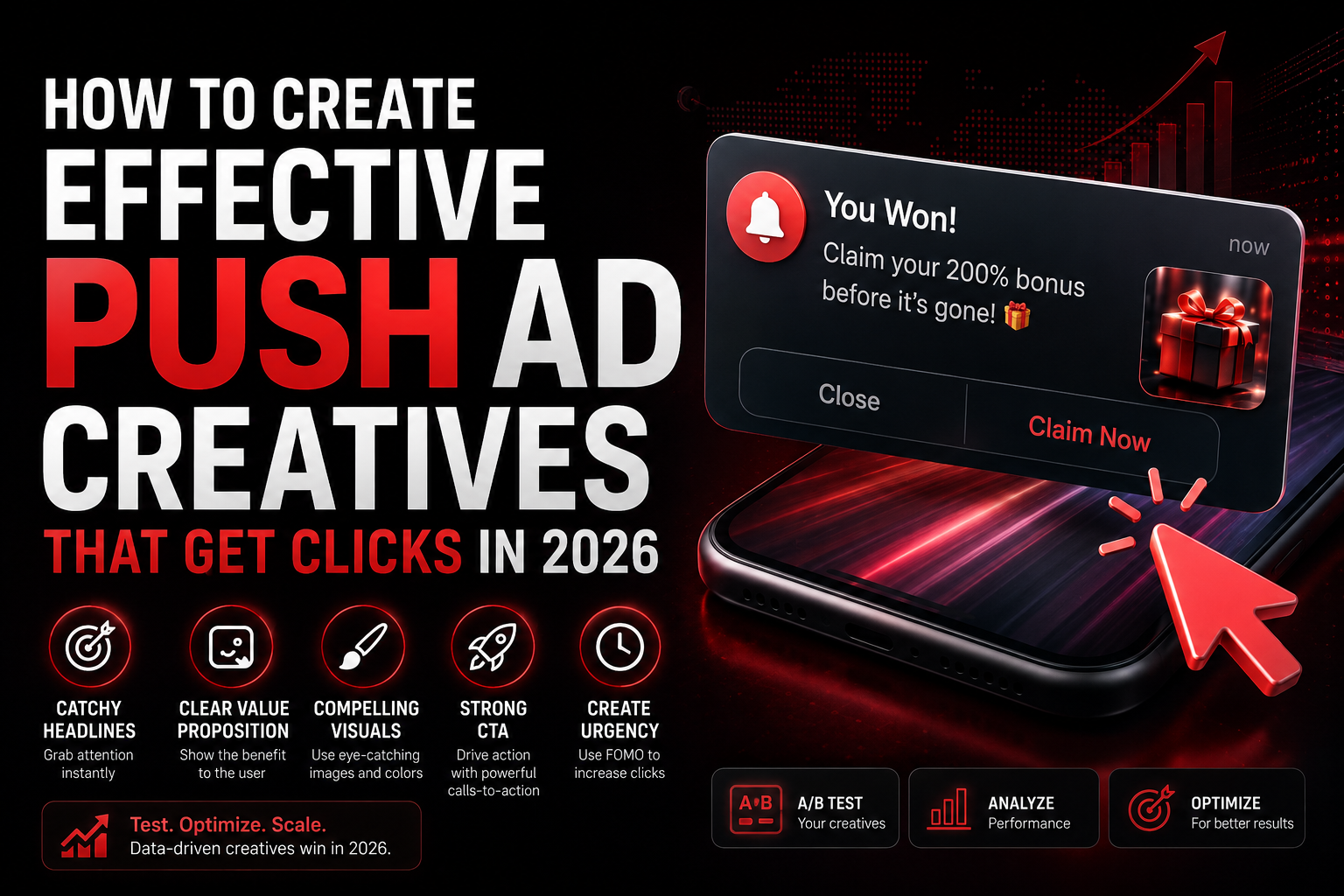
Key Takeaways
- A push creative = headline (up to 30 characters) + description (up to 60 characters) + icon
- Question headlines boost CTR by 10–15%, but don't always improve CR
- Emojis increase CTR by 4–5% on average but reduce trust in finance verticals
- Minimum 3–5 creative variations per test, 200+ clicks per variation
- Push audiences burn out faster than other formats — rotate every 2–3 weeks
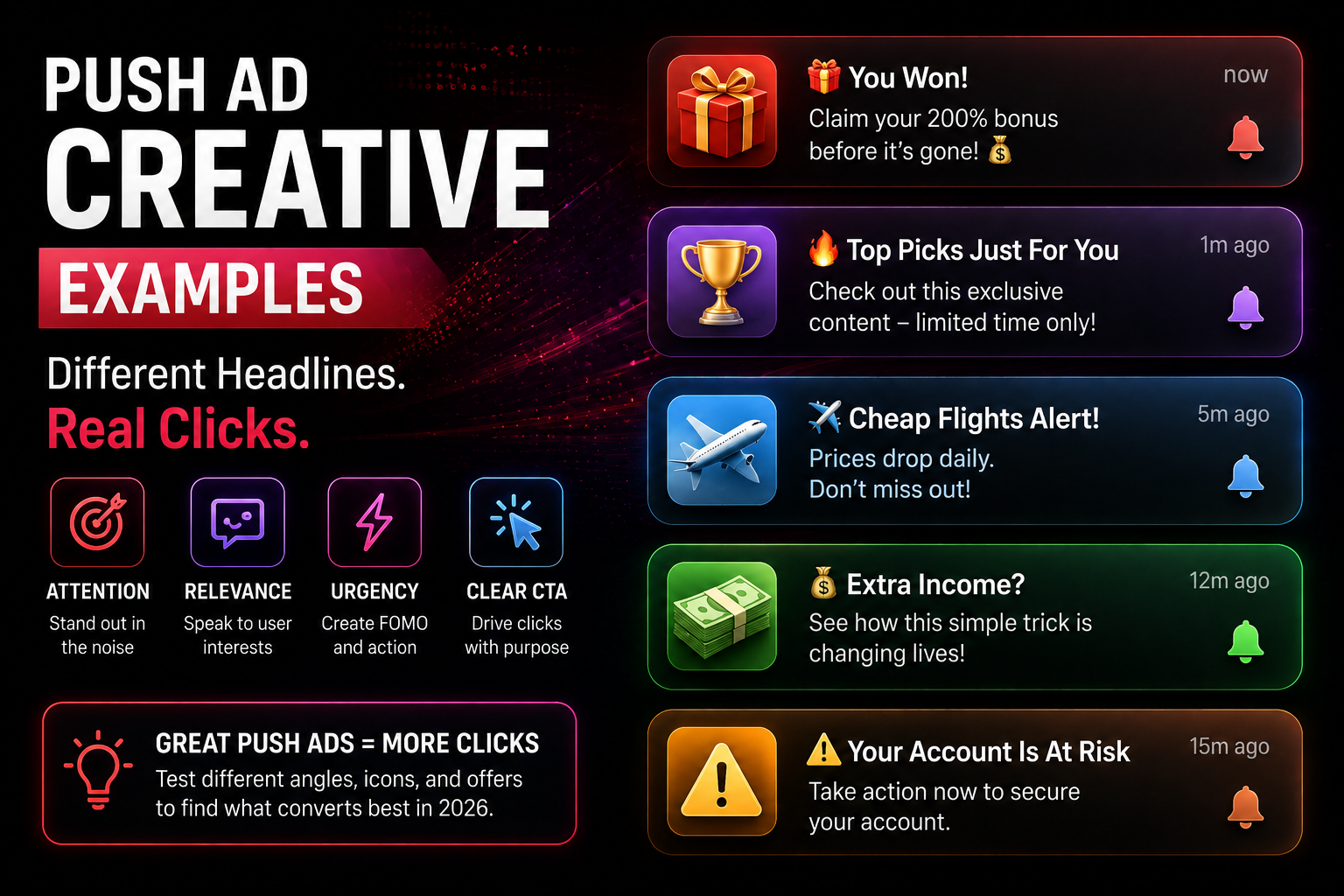
What Makes Up a Push Creative and How Each Element Affects Results
A push notification is a small block that appears on the user's screen on top of other content. The buyer has three tools to make the user click instead of swipe. The headline is the first thing that registers. It determines whether the eye stops. That's 80% of CTR. The description supplements the headline. It answers the question "why should I click" and adds specifics that didn't fit in the headline. The icon is the visual anchor. It works faster than text: a bright color and recognizable image attract attention before the user reads the headline. On AdsCompass, push runs on CPC — you only pay per click, which means creative quality directly determines how many clicks you get for your budget. A weak creative means fewer clicks, less data for optimization, and a slower path to profitability. Per IAB standards, ad creative quality is among the factors defining user experience and placement effectiveness.
How to Write a Headline That Gets Clicks
The headline is the most important element of a push creative. 30 characters to stop the eye of a user who sees dozens of notifications daily. There's no room for warm-up — every word has to work. A pattern I observe across AdsCompass accounts: a headline that triggers a specific emotion or asks a question gets clicked more than a headline that describes the product. "Your bonus is waiting" performs worse than "Forgot to claim your bonus?" — even though they say the same thing.
Question vs Statement
A question headline boosts CTR by 10–15% compared to a declarative one. The reason: a user can't help but mentally answer a question, and that delays attention on the notification. "Want Free Coins?" gets clicked more than "Free Coins Available." But honest tradeoff: questions generate curiosity clicks. The user clicks to find out the answer, not because they want the product. If the landing page doesn't satisfy that curiosity immediately, CR drops. Questions work when the click leads to an instant answer or benefit.
Length and Characters
30 characters is the formal limit, but the real benchmark is 20–25. On mobile devices, the headline gets truncated after 25–28 characters depending on OS and screen resolution. If the key information is at the end, the user won't see it. Put the most important content in the first 3–4 words.
Honesty vs Clickbait
Clickbait delivers high CTR on the first run. But advertisers working with push on CPC pay for every click — and if the user sees an irrelevant landing page after clicking, CR drops to zero, the zone gets poor statistics, and eCPM for the publisher declines. Clickbait works against both sides. An honest headline with a specific benefit delivers slightly lower CTR but higher CR — and ultimately a lower cost per conversion.
How to Write a Description That Pushes Toward the Click
The description isn't a repetition of the headline — it's its complement. 60 characters for one task: give a reason to click right now. If the headline is the hook, the description is the argument. Three approaches that work. First: specifics. "$50 bonus for new users" is stronger than "Get a bonus." Numbers, amounts, deadlines — anything that makes the offer measurable. Second: urgency. "Today only," "3 hours left," "Last chance" — these create pressure that shortens the path from view to click. But don't overuse it: if "last chance" appears every day, users stop believing it. Third: CTA verb. "Claim," "Check," "Open" — a direct call to action works better than descriptive constructions.
Honest tradeoff: descriptions get truncated even more aggressively than headlines. On some Android devices, only the first 40 characters are displayed. Test how your copy renders on real devices — or place key information in the first 35 characters.
Which Icon Works Best
The icon is the element that works faster than text: the user sees color and shape before reading the headline. According to Statista, visual elements are processed by the brain 60,000 times faster than text — and in a push format where contact lasts 1–2 seconds, the icon can determine whether the user reads the headline at all.
What works: bright colors (red, orange, yellow) on a contrasting background. Faces and emotions — a human face attracts attention more strongly than abstract symbols. Recognizable images tied to the offer: a coin for finance, a shield for VPN, a gift box for sweepstakes.
What doesn't work: fine details that are unreadable on a small icon. Text inside the icon — it's illegible on mobile. Muted, monochrome colors that blend into the notification background.
Emojis in the headline and description are a separate topic. On average, emojis increase CTR by 4–5%. Face emojis (😲, 🔥, ⚡) perform better than object emojis. But in finance, utilities, and B2B verticals, emojis can reduce trust — the audience perceives them as "unserious." Test: one variation with emojis, one without — and compare not just CTR but also CR.
How to Test Creatives: A/B Testing with Specific Thresholds
Launching one creative and hoping it works isn't a strategy. Minimum 3–5 variations per test. Variations should differ by one element: three different headlines with the same description and icon — or three different icons with the same copy. If you change everything at once, you won't understand what actually affected CTR.
Data threshold for a decision: minimum 200 clicks per creative variation. With fewer clicks, CTR differences may be statistical noise. At 0.01–0.03 CPC, that's 2–6 per variation — affordable even on a minimal budget. After accumulating 200+ clicks, compare each variation's CTR and CR. Keep the leader, disable the underperformers, and launch new variations based on the winning element.
Honest tradeoff: 10+ creative variations slow down data collection. Budget gets distributed across all variations, and each needs 200+ clicks. With 10 variations and 0.02 CPC, that's 40 just to test one element. For budgets under 200/month, 3 variations is optimal.
What Mistakes Kill Push Creative CTR
The first: one creative for all GEOs. An English headline in Brazil, European faces in the icon for Indonesia, dollar amounts for an audience that counts in rupees — all of this kills CTR instantly. Localization isn't text translation — it's adapting visuals, currency, and cultural context.
The second: not testing icons. Buyers spend hours on headlines and ignore the icon — even though it determines whether the user reads the headline at all. Changing the icon can lift CTR by 20–30% without altering the text.
The third: not refreshing creatives. A push audience is a subscriber base, and the same people see your notifications. A creative that delivered 1.5% CTR two weeks ago may deliver 0.3% after a month. Rotation every 2–3 weeks is the minimum.
The fourth: evaluating creatives by CTR alone. High CTR with zero CR means the creative attracts clicks but not the right users. Evaluate creatives by cost-per-conversion, not clickability.
How Creatives Work on AdsCompass
On AdsCompass, push creatives are uploaded in the self-serve advertiser dashboard when creating a campaign. Each creative includes a headline (up to 30 characters), description (up to 60 characters), and icon. Multiple creatives can be added to a single campaign — the platform rotates them automatically and shows statistics for each one separately.
The link between creative and optimization: creative CTR affects click volume per zone, which directly determines how fast you collect data for white- and black-lists. A strong creative means more clicks, faster statistics, and faster optimization. The AdsCompass blog contains guides on campaign setup, zone management, and tracking — together with this article, they form a complete cycle from launch to scaling.
Push runs on CPC — you pay only per click. The higher the creative's CTR, the more clicks you get for the same impression volume, and the faster you collect optimization data. On the AdsCompass auction, creatives with higher CTR receive priority at equal bids. The platform covers 200+ GEOs and processes over 900 million impressions daily. For publishers, quality advertiser creatives mean higher CTR on zones, which raises eCPM and attracts more demand. To get started — sign up and upload your first creative variations.
FAQ
How many creatives should I launch simultaneously?
3–5 variations is optimal for most tests. Fewer than 3 isn't enough for comparison. More than 5 spreads the budget too thin, and each variation takes too long to accumulate 200+ clicks. For budgets above 500/month, 5–7 variations can be tested.
How often should push creatives be changed?
Every 2–3 weeks. A push audience is a subscriber base, and the same users see your notifications regularly. CTR declines by 15–20% per month without rotation. Monitor CTR by day: if it drops for 3 consecutive days, it's time to change the creative.
Do emojis increase push ad CTR?
On average, yes — by 4–5%. Face and emotion emojis (😲, 🔥, ⚡) outperform object emojis. But in finance, utilities, and B2B verticals, emojis can reduce trust. Test: one variation with emojis, one without — and compare not just CTR but also CR.
What CTR is considered good for push?
0.5–1.5% is the working range. Above 2% is an excellent result. Below 0.3% means the creative needs changing. CTR depends on GEO, vertical, and subscriber base freshness: fresh subscribers (0–7 days) deliver CTR 3–5 times higher than a base older than 30 days.
Does the creative affect cost per click?
Directly — no: CPC is determined by your bid. Indirectly — yes: a strong creative with high CTR delivers more clicks for the same impression volume, which lowers the effective cost per conversion. On the AdsCompass auction, creatives with higher CTR receive priority at equal bids.
Can I use the same creative for different GEOs?
Not recommended. Language, currency, visual associations, and cultural context differ between GEOs. The same English headline can deliver 1.5% CTR in the US and 0.2% in Brazil. Minimum localization means translating the text and adapting amounts to local currency.
About the Author
Vlada, Business Developer at AdsCompass. Works with advertisers and publishers in digital advertising, specializing in performance formats and international markets. Helps partners build traffic acquisition and monetization strategies across 200+ GEOs.