



The choice of ad format shapes campaign economics no less than GEO or creative. The same offer run on popunder and native will deliver fundamentally different results in terms of CPM, CTR, and data collection speed. Below is a breakdown of the five key formats available on Adscompass, along with recommendations on how to apply them.
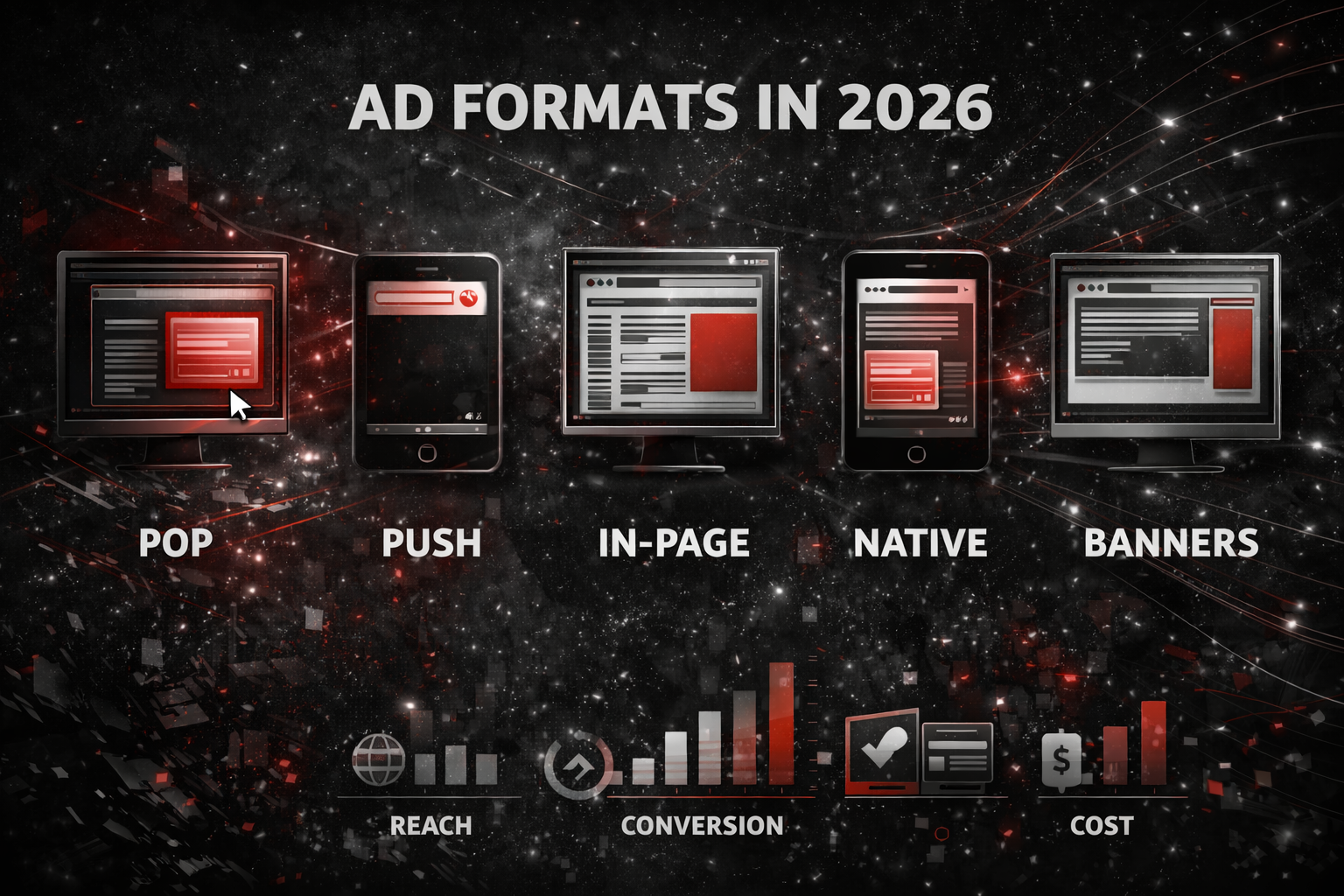
Pop: Maximum Volume and Testing Speed
Pop is a format in which the advertiser's page opens in a new window or tab after a user clicks on the publisher's site. Over the years, it has retained its main advantage: substantial traffic volumes at a minimal cost per click.
Adscompass specializes in Pop traffic: the platform provides large volumes of direct traffic from its own publishers, while the built-in anti-fraud system filters out low-quality zones at the purchasing stage. This resolves the format's main challenge — source quality — and makes Pop on Adscompass an optimal choice for both scaling and initial testing.
Push: Working with Opt-in Audiences
Push refers to notifications users receive after voluntarily subscribing on a publisher's site. The format reaches an audience that has already consented to advertising messages, and it is characterized by a predictable response rate and high CTR when paired with a well-crafted creative.
Push is suitable for recurring campaigns, repeated touchpoints, and work with segmented audiences. Its main limitation is the gradual "burnout" of the subscriber base, which requires regular creative updates. On Adscompass, Push is available with flexible targeting by GEO, device, and operating system.
In-page: An Alternative to Classic Push
In-page visually replicates a standard push notification but is displayed directly on the website while the user is browsing. The format does not require a subscription and works correctly on all devices and operating systems, including iOS, where classic Push is technically limited.
This makes In-page an optimal solution for campaigns targeting iOS audiences and for GEOs with traditionally low push subscription rates. The format preserves the visual logic of a push notification while expanding reach by removing the subscription barrier.
Native: Integration into Content
Native is a format in which the ad's image and headline visually match the design of the publisher's website. Users perceive such ads as part of the content, which increases trust and reduces banner blindness.
Native is suitable for tasks where engagement quality matters: long conversion funnels, educational content, and brand-focused campaigns. The format requires more careful creative work but delivers higher-quality traffic in return.
Banners: Reach and Branding
Banners are ad units placed in fixed positions on a publisher's page. The format's strength lies in visual control: the advertiser knows in advance how and where the creative will be displayed and can build a campaign precisely aligned with branding objectives.
Banners are effective for building brand awareness and supporting performance campaigns running in other formats. Combined with Pop or Push, they enhance the effect of repeated touchpoints and improve overall funnel conversion.
How to Choose a Format Based on Your Goals
The choice of format is determined by campaign objectives. For testing hypotheses, collecting initial data, and scaling in Tier-2/3, Pop is the optimal choice. For repeated touchpoints and work with loyal audiences, Push is the right fit. For iOS traffic or GEOs with low push subscription rates, In-page should be used. Native is recommended for campaigns prioritizing engagement quality, while Banners address branding and reach objectives.
The most effective strategies are built on a combination of formats. Adscompass provides all of the listed formats within a single self-serve platform covering 200+ GEOs, enabling complex campaigns to be launched without connecting additional traffic sources.